Monday, September 26, 2011

Interesting Author Spotlight: 円城塔 (Enjoe Toh)

I came across this author by chance. I was looking through the Shinchou literary magazine's Twitter feed and noticed it mentioning a book that I thought had a very interesting title:

「これはペンです」
"This is a Pen"
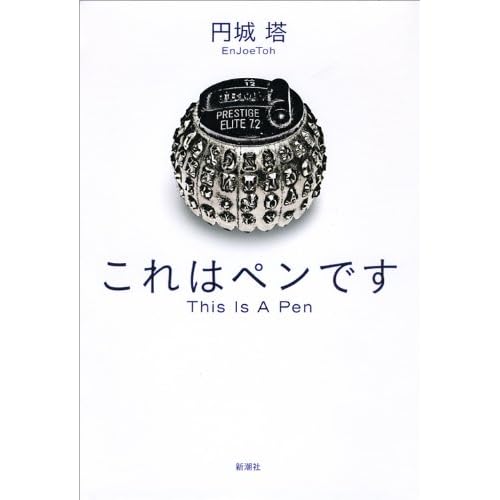
I'm not going to lie—I'm a sucker for titles. The description on Amazon is interesting though:

"Uncle is a letter. Literally. A man who invented an automatic sentence generator and his brother who has vivid memories of a town that doesn't exist. A tale of twins that illuminates the origins of reading and writing."

Definitely sounds like something I would want to read. I did a little more research, and found out that "This is a Pen" was a finalist in the Akutagawa Prize earlier this year.

Then shit got real! In a strange instance of serendipity/coincidence/it's-a-small-world-after-all-ism, I actually own two pieces by Enjoe Toh. In the January 2011 issue of Bungakukai, he has a short story called "Magnitude," and he has a story (novella, perhaps, it's very long) in the Best Sci-Fi of 2007 collection "Imaginary Engines," the same collection that contained the 2010 Kurodahan Translation Prize piece "忠告."

Anyway, he sounds like an interesting author. He graduated from Tohoku University studying physics, and then went to Tokyo University for graduate school. Wikipedia doesn't specify him as anything besides a novelist, but he definitely seems to have a sci-fi bent. For instance, another short story title: "The History of the Decline and Fall of the Galactic Empire."

He's had other pieces nominated for the Akutagawa, but he has yet to win it. However he has won the Noma Literary Prize and the Bungakukai New Writer's Prize, and has been nominated for the Gunzo New Writer's Prize and the Yukio Mishima Prize. 

I started reading "Magnitude," but it's...confusing. I'm not even sure I can explain it. It starts by explaining some sort of weird number theory. Here's a very short, probably poor translation of the very beginning:


"9


In twenty years, we learn the world approaches ten.


Now is still nine. They say a hundred years ago was eight. China and India, nine. The entire planet, nine. Only Japan is eight. Next, they say, decline will begin, and in time, it might be seven. It was seven a hundred years ago.

I am 0..."

It goes on to explain a very strange theory about zero and it's relationship to other numbers, and how zero is also known as, you guessed it, "magnitude."

I...don't even know. I plan on spending some more time fighting my way through this story, but I'm not sure what I'm going to get out of it. "Palimpsest" is quite long, but since I have it, I might as well take a look.

If you want to try reading some Enjoe Toh for yourself, he has a serialized Twitter novel at the username @EnJoe140, separate from his own Twitter account @EnJoeToh. I think it's all done; it hasn't been updated since September 17th.

You can also pick up Kurodahan Press's Speculative Japan 2, which has a translation of Enjoe's story "Freud" (haven't read it, but of course, now I want to).  

Enjoe Toh might be a name to look out for in the future.

Saturday, September 17, 2011

September 2011 Japan Book News

Fall has (basically) arrived and with the changing of the seasons comes a new issue of Japan Book News.

If you don't know, Japan Book News is published quarterly by the Japan Foundation. It's full of articles and news about the current Japanese literary culture, as well as a list of notable new releases. It's a great resource for finding out what books are making a stir in the Japanese literary community.

Volume 69 is now up, but unfortunately, the link to downloading the full PDF of the issue is broken, so you can't read the news and articles just now. They do have links to the summaries of the new releases though, and they've highlighted a couple very interesting seeming books. Here's a look at what I'd be interested in getting my hands on:

(Unfortunately, they use Javascript to link to all their internal pages, so as much as I'd like to, I can't give you a direct link to everything they're talking about. You'll have to go the main page, and click your way through to the index for Volume 69 to see more information about these titles. All links are to Amazon Japan product listings.)

1)雪の練習生 ("The Apprentices of Snow," their translation not mine)
by Yoko Tawada

Yoko Tawada has a number of works out in English. I read The Bridegroom was a Dog a while back, but I just read the short story collection Where Europe Begins put out by New Directions, and now I've become a huge fan. Tawada is so surreal and inventive, and she can manipulate these qualities into something either extremely beautiful or extremely disturbing, sometimes practically instantaneously. She writes in both German and Japanese (Where Europe Begins was mostly her German work), but I'm assuming that she wrote this one in Japanese.

Anyway, it's about polar bears. Not just about polar bears, narrated by polar bears. And not just any polar bears. A polar bear trained for the circus who writes a memoir and becomes a famous writer, for one.

Writing from the point of view of a personified animal seems to be in vogue right now in Japan. Belka, Why Don't You Bark? by Hideo Furukawa follows dogs (I think it's narrated by the dogs but I'm not sure), and Kenshin by Rieko Kawakami is about a woman who is turned into a dog. Either way, interesting premise, great writer—I'd love to see this come out by New Directions, who has published a lot of Tawada in the past.

2) 生首 ("Severed Heads")
by Henmi Yo

There's a pretty robust poetry scene in Japan, some of which gets across the Pacific Ocean. The Best Translated Book Award has always had at least one Japanese poet on their shortlist save their inaugural year. I'm not familiar with Henmi Yo really, but I don't think Japan Book News highlights a lot of poetry, and I do like the little excerpt they put in their description:

One evening in early autumn
Across the darkening blue of the western skies
I watched a severed head fly across the heavens.

Not a lot to go on, but worth checking out I think. 

3) 日本語ほど面白いものはない (Nothing is as Fun as Japanese)
by Naoki Yanase

I can't imagine anything like this would EVER get published in English, but it sounds interesting to me all the same. It's based on a series of lectures given by Yanase to a sixth grade class on why Japanese is a cool language. The reason why it's interesting to me is Yanase himself, who did Japanese translations of Roald Dahl and Lewis Carrol, as well as James Joyce's Finnegans Wake. Finnegans fucking Wake! I would LOVE to learn more about this guy.

Hey, and maybe since it's written for sixth graders, it would be pretty easy to read, and it might make a good supplementary textbook for American high school or college students learning Japanese. Maybe there's a market for this book after all.

4) 日本の刺青と英国王室 ("Japanese Tattoos and the British Royal Family")
by Noboru Koyama

Title sort of explains it all. About British Princes in the late 19th century that did some tourism and got some badass tattoos, and then more about the history of Japanese tattooing. I don't read a lot of history books, but this sounds pretty fascinating.

5) 文豪の食卓 (Great Writers at the Dinner Table)
by Tokuzo Miyamoto

OK, this one might appeal to me only. I love food, and I love to read about famous people talking about food. So from what I understand of the description of this book, it's part profiles of famous writers through their documented experiences with food and part exposé about regional Japanese food. It seems like it profiles a lot of French and American writers (though there must be something about Japanese writers). I love this kind of stuff, though I can't imagine it ever being published in translation.

6)近代日本奇想小説史:明治編 (A History of the Japanese Imaginative Novel: Meiji Era)
by Jun'ya Yokota

Another history book, but this one about science fiction, speculative fiction, and other genre fare of the Meiji Era. It's 1200 pages though—I'd never get through it. I'd rather read about the neat stuff No-sword digs up.


There's also a new book by Yuko Tsushima, who I was never a fan of, and a history of Japanese mystery novels, which they hilariously call "much-neglected," cause seriously, what is being translated in America besides mystery/crime/thrillers and Murakami?

Anyway, good selection of cool stuff. Check it out, especially you publishing types if you're out there—let's get some cool stuff translated into English!


Friday, September 9, 2011

1Q84, Murakami, and His English Translations

Greetings again. I've come back from the void that was the summer with some (hopefully) more regular posting.

So the big news in the Japanese literature world, of course, is Haruki Murakami's forthcoming English translation of 1Q84, coming out October 25th. And if you're impatient, there's all sorts of stuff out there to get a little amuse bouche before the 900-page smorgasbord arrives.

A few months ago The Millions had the first paragraph, but that was usurped just a few days ago by Murakami's Facebook page, which now has the entire first chapter for you to read (the only caveat being you have to first "Like" Haruki Murakami's page to gain access). There's also a nice standalone excerpt in the latest New Yorker called "Town of Cats."

If you're interested in reviews, you can see The Literary Saloon's extremely favorable review of the first two books (scroll down), Publisher's Weekly's starred review, The Japan Time's reviews for parts 1 and 2 and then 3, and even fellow bloggers How to Japonese's less than favorable reaction and subsequent review at Neojaponisme and Nihon Distraction's (the lucky sun of a gun who got an advanced review copy) take on book 1.

I haven't actually read any of these, because for some reason I've started feeling very spoiler-averse to the point where I don't really want to know any more about the plot than the little I already do. The only thing I know is pretty much everyone (with the lone, possibly lonely, exception of Daniel from How To Japonese) loves it.

There's also a book trailer, but it's pretty lame.

The English translation has been long-coming. The Germans for example have had a translation out for like a year now, and the French are beating us by a month or so. If you didn't know, the English translation is being done by two people: Jay Rubin and Philip Gabriel. Jay Rubin started on books 1 and 2 before it was clear that there was going to be a book 3 coming out, where they hired Gabriel to speed up the process and to facilitate a one gigantic volume release. (I speculated about the implications about this a long time ago at Three Percent. Almost two years ago actually: notice how they initially planned on publishing the translations in two separate volumes).

This is all a relatively long and pointless segue leading to something I found regarding Murakami and his thoughts on his English translations. In「そうだ、村上さんに聞いてみよう」("Hey Yeah, Let's Ask Murakami!"), the collection of Q&As Murakami hosted on his website where you could ask such pressing questions as "Do you like Nicolas Cage?", one reader asks about Murakami's feelings towards his English translations. Keep in mind that this is from 1997. Translation follows:

---
Pressing Question #46
Thoughts on Your English Translated Works?
At 12:46 AM 1997.08.09


I live in New York. Since I've been in Japan I've read almost all of your works. After I came here I tried reading them in English. Have you ever read your novels in English translation and thought anything like, "Hmm, that's not quite right"? There's a lot of problems with my English comprehension skills, so I feel pretty lucky I can read your novels in Japanese. (TV Director, 33 years old).


Hello. For me, translation is all-around approximation. And filling that ditch of approximation is a matter of love of devotion. If you have love and devotion, you can overcome just about everything. What I mean by this is that I trust my translators, and I think that's the most important thing. At least to a certain degree, of course.

As a rule, I don't reread what I've written, so even when I flip through the pages of the English translation, I completely forget what even the original was, so I skim through it going, "Hahaha, isn't that interesting?" I think that's better for my health. 

From 「そうだ、村上さんに聞いてみよう」と世間の人々が村上春樹にとりあえずぶっつける282の大疑問に果たして村上さんはちゃんと答えられるのか?, Asahi, 2000, p. 43.


Saturday, August 6, 2011

Recently Read Round-Up, July 2011

I think I'm going to try making the RRR a monthly thing. I get to highlight a number of interesting books, without the undertaking being too large that I end up putting it off indefinitely. I'm saying this entry is for "July" but in truth it also covers the last third or so of June. If I get good at these round-ups and more ambitious I won't lean so heavily on what I've already written on Goodreads, and make it more of a capsule review type thing. The headline still includes "literature" underneath Wednesday Afternoon Picnic, so I hope the expansion into non-Japanese literature reviews will still be welcome to you all.

Again, you can find me on Goodreads here, to follow in real-time (Oh my gosh so exciting!) what I'm reading.

Seventeen and J: Two Novels, Kenzaburo Oe
Translated by Luk Van Haute

2 out of 5 stars

Although Oe often uses these themes in his body of work, the two novels (said designation being extremely generous; they're novellas, really) gathered here are connected by the themes of politics and sexual perversion. And I'm sure at the time, when Oe was young and with not a lot of work to his name, these two pieces were quite extraordinary in a Ooh-look-at-this-literary-wunderkind-so-much-talent-for-his-age kind of way. But now that we know what Oe's work would become with time and practice, the novellas here are quite lackluster, frankly. Oe at his best uses extreme elements with a light touch, grace, nuance, what have you. Nuance is the last thing on display in these novellas.

Seventeen is about a masturbating (seriously, the narrator is constantly talking about and/or doing it), self-loathing teenager who becomes a member of the youth nationalist movement. It's a straw-man argument, basically, associating this totally hateful, pitiful character with conservative politics, and Oe's fiercely leftist tendencies are so obvious and hamfisted he got death threats and harassment from said right party for Seventeen and it's sequel (which, as noted in this book's introduction, Oe refuses to have translated out of legitimate fear from the response he got publishing it in the first place). J is almost two completely separate stories linked by one character, the first about J's wife shooting her art film with a bunch of their mutual friends/sexual conquests, and the next taking place sometime in the future and follows J as he helps induct a young ward in the ways of being a chikan, men who sexually harass women on the train.

Both deal with some heavy, twisted stuff but Oe doesn't know how to handle them really—it feels like he's writing purely for shock value, to illustrate/tie thematically to whatever he wants to complain about in the state of affairs of Japan. Oe is an unbridled idealist in these works, and they exist purely to pummel you into a conceptual submission. Seventeen and J are interesting from a historical perspective, seeing evolution in Oe's writing and the effects these incendiary works would have on the public, and then back to him, but they're not the best literature. Oe is capable of much better.


Mist, Miguel de Unamuno
Translated by Warner Fite
 
4 out of 5 stars

The original nivolla (you'll understand this term if you read the book). This book was recommended to me by a translator/student friend who workshopped a translation she did of Unamuno. I loved the short story she translated, and she suggested I read this novel for more.

Mist has a whisper-thin plot—man falls in love with a woman who's in love with someone else sort of deal. But plot isn't really quite the point of the novel.  It's a thoroughly post-modern/meta-fictional book, though it came out well before either of those terms existed. I don't really want to spoil the surprises in store, but I will be frank, you might find it kind of boring in the beginning (at least I did). The whole thing starts to unravel, so to speak, in the second half, but if you like meta-fictional games in your books, read Mist, one of the earliest. I might have to reread it, in case there are things to catch in the beginning that I couldn't appreciate not knowing the end.


The Art of Fiction, John Gardner

4 out of 5 stars

I'll confess: I have literary aspirations besides those of translating. I wouldn't say I'm any good, but I enjoy it doing it, and getting feedback and seeing how I can improve, and I certainly love the idea of being a novelist... The goal for me now is to start practicing regularly now that I'm not taking classes in the subject. We'll see if I ever get anywhere with it.

So I picked up this of the many guides, because one, John Gardner, and two, my own creative writing teacher mentioned in passing as one of the good ones.

Gardner is hilariously judgmental in this book, and has almost impossibly high/old-fashioned standards of literature, but the information and lessons here are undeniably useful and easy to grasp. I wouldn't agree with everything Gardner says about the art of writing literary fiction (though who am I to argue against him) but his thoughts are so well laid out that reading this book would be helpful for anyone, if only to figure out where s/he stands. At the very least an interesting read if you're into this kind of thing.

After Dark, Haruki Murakami
Translated by Jay Rubin


3 out of 5 stars (maybe 2.5 out of 5)


This is technically a reread, since I read After Dark immediately after it came out the first time. 

You know what? After Dark is not that great. I feel like everyone was on a Kafka on the Shore high when After Dark came out in America, because the reviews are generally pretty positive. It's definitely my least favorite Murakami novel now, which is funny because the previous loser, South of the Border, West of the Sun got way better on my second read-through last summer. 

Sure, After Dark has got some great atmosphere;  it's real nice and tense, and it's got some interesting characters. The problem is that we don't "know" them like we know characters from other works, and After Dark is not as clearly "about" something as his other works. And Murakami explores duality and "this side/other side" themes more clearly and eloquently, I think, in other works, like Sputnik Sweetheart. I don't know. On the whole I came away a little disappointed. Not bad, per se, but I feel now like it's a little overrated. 

How to Live Safely in a Science Fictional Universe, Charles Yu

 4 out of 5 stars 

I fell hard for this book. I wanted to give it 5 stars. Or if Goodreads did half stars, 4.5. It was by far the most fun I've had reading in a long time (I fell hard for Lev Grossman's The Magicians in a similar way).

I suppose it's because I don't read a lot of genre fiction anymore, and while this definitely has a sci-fi bent, it is still very literary. So the sci-fi elements made for a really good novel on a plot-level, but the thematic and emotional resonance made it a story that stuck with me in a way that only good to great literature does. 

Plot-wise, a basic synopsis would be that the narrator is a sort of time-travel machine repairman, adrift and lonely, the only child of a time-travel obsessed father and a put-upon mother. Eventually he sees his future self and accidentally/impusively kills him, causing himself to be stuck in a time loop.

 The novel reminded me of a number of different things. It reminded me of Murakami in a couple different ways, partially because of Hardboiled Wonderland and the End of the World's sci-fi bent, but also Hear the Wind Sing and Pinball, 1973's fragmented style and depressed, adrift loner first person narrator. And it also reminded me of A Wild Sheep Chase in that it starts off sort of not about anything but then all of a sudden, much later than you might expect it to, gets very plot-heavy. But it also reminded me of George Saunders, particularly in his novella Pastoralia, in that it deals with a absurd, weird, almost fantastical job that's presented as if it were the most banal thing in the world. A very potent combination, and Yu has some hilarious one liners, and also some of the most emotionally wrenching passages too. 

The only drawback is that time travel stories are basically impossible to be fully satisfying. They almost always end in some sort of weird way, whether totally confusing or illogical or by some deux ex machina, which is sort of a necessity, because otherwise, well, the whole infinite loop thing. But this book was SO much fun, that I would recommend this book to just about anybody. I am very much looking forward to reading more of Yu's work.


The Private Lives of Trees, Alejandro Zambra
Translated by Megan McDowell
4 out of 5 stars 

This was another book that I was kind of surprised how blown away by how good it was. It's quietly powerful, especially given that it is so short—only 90 odd pages. 

It starts off with Julian telling a bedtime story to Daniella, the daughter of his wife Veronica, about trees who basically just sort of chat with other. But the narrative digresses to Julian's romantic past, how he met Veronica, Daniella's potential future life, etc. The narrator states clearly early on that the novel will end when Veronica comes home, but as the novella goes on, it becomes increasingly unclear whether she will come back at all. 

I can't help but make another Murakami comparison; in this case, it reminds me of the short story "Honey Pie" from after the quake. The similarities are pretty intriguing, though in all likelihood completely coincidental. They both follow failed/struggling writers (Julian wants to write but seems to have writer's block of some kind; Junpei can only write short stories but not a novel; also I just noticed their names start with J) and both stories start with the telling of a bedtime story about anthropomorphized non-humans (bears in "Honey Pie," trees here) to a girl that is not biologically theirs. They also, at least to some extent, have to deal with the hardships of new, makeshift families. Tonally they are quite different; "Honey Pie" overall is a happy story, with a touch of melancholy, Trees has sort of the opposite proportions. Trees is incredibly moving however, made all the better that it's a story that you can finish in one sitting, while at the same time deeper and more satisfying than just a short story. I highly recommend it, and I super want to read Zambra's Bonsai now too. 

And that's what I've read this past July (and some of June). I also started David Foster Wallace's Girl With Curious Hair, though I have many more stories to read, and am halfway through Kevin Brockmeier's latest novel The Illumination. Look forward to reviews of these in roughly a month's time.


Monday, July 25, 2011

Genichiro Takahashi, Essayist

Genichiro Takahashi, author of the amazingly great novel Sayonara, Gangsters, a book anyone with an interest in Japanese contemporary/post-modern/metafiction should read immediately, is also a prolific literary critic and essayist.

This seems to be a common thing in Japan, when you achieve a certain level of notoriety. Murakami, for instance, has collection after collection after collection of all the various essays, commentaries, and fluff pieces he's contributed to magazines, newspapers, etc. Certainly American authors are somewhat active outside of their respective fiction writings, but I think it is less common than in Japan—especially for publishers to bother republishing them in a collection. (I can only think of the highest tiered American authors having these sorts of essay collections, but this is a personal, not fully informed observation. Please let me know in the comments if I am mistaken about either country.)

I do think Genichiro Takahashi deserves special mention for his literary criticism and essays though, because by his own admission he finds himself to be better known to the public as a critic than as a novelist. He even writes serialized essays on his twitter account, called "Midnight Novel Radio."

I have three of Takahashi's non-fiction collections that I have browsed briefly through with the intention of diving in more thoroughly soon: 一億三千万人のための小説教室 ("Novel Writing Class for the 130 Million People of Japan"), 文学王 ("The King of Literary" is the official subtitle), and 平凡王 ("The King of Ordinary"). "Novel Writing Class" is the one I've looked at the most, and is hilarious, and "The King of Literary" has essays on his favorite novels (Natsume Soseki's unfinished 明暗, "Light and Darkness" is one) among various other things.

He also has been quite outspoken after the March tsunami and earthquake, including two articles in the Asahi Newspaper (English versions available here and here) and another in the New York Times.

Finally, Takahashi maintains a semi-regularly updated column at MAMMO.TV. (Totally off-topic, but check out this other columnist Takano Masanori—he looks like a Japanese Charlie Sheen.) The topics run all over the place: many on the quake recently, but also on less weighty matters, like the shamelessness of Trading Card Games that force kids to constantly be spending more money on them."Battle Spirits" is what his son is obsessed with, and if you watch the link, it looks EXACTLY like Yu-Gi-Oh. Exactly. (I personally, back in the day, blew all my money on Magic: The Gathering...)

For today's post, I translated his first column at mammo.tv for your enjoyment.

ー
"My Friend's Bookshelf"


It was in the fall of my first year of middle school when I entered a private school in Kobe. That would be about 40 years ago now. The me then (and I think this was only natural for my age) was a normal middle schooler who of course had no interest in literature, but liked manga instead.

It was after I entered my second year of middle school that I became acquainted with T. The school was part of an integrated middle and high school system, but you still had to take exams to get in, so while all the students were convinced they had to be studying all the time, T was a bit different from everyone else. T was always reading books. Literature, ideology—those kinds of "deep," "difficult" books.  The people around T respected him for it, and students with similar interests gathered around him. And then somehow I started puttering around them too. That's when I noticed that something was going on. I quietly listened to T and everyone gathered around him. They brought up all these names of authors, poets, jazz musicians, and film directors in their conversations. And I didn't know a single one!

Before I knew it, I became one of the people who hung around T too. I would memorize the titles of the books they all talked about, go to the bookstore, buy said book, and go home to read them (though I didn't understand them at all).

One day, I and a couple of other friends were invited to T's house, where we went into his room. The guys who had been there before started talking with T immediately. I, on the other hand, gazed hungrily at T's bookshelf. The bookshelf, which covered an entire wall, was crammed pull of  those "deep," "difficult books that I didn't know. I wondered if I could become a great, fully-fledged adult by reading all these books. Impossible right?

No way, not in a million years.

After that, until I graduated high school I would go to T's house and copy down the names of his books (as I didn't feel like I could borrow them). And when copying down these titles was too embarrassing, I memorized them. Then, stretching far beyond my own capabilities, I read them— even though I didn't get them at all, to the point it made me dizzy. All I could think about how nice it would be if I could catch up with T. T and I graduated high school, and then we went to different universities, and after that took up different jobs: T a journalist, and I a novelist. No matter how I think about it, I feel like it should've been the opposite.

One month ago, I received a notice from the newspaper that T disappeared. T, who was in Malaysia on vacation, told his wife that he was going to go swim at the beach by their hotel, went out into the shoals, and just like that, never came back. And now my chance to thank T for his bookshelf is lost forever.

Monday, July 11, 2011

Kurodahan Press Translation Prize 2011

And we're back! Two and a half weeks go by fast, don't they? If only this blog could be my job! (Then I wouldn't be so broke or stressed out...)

Anyway, no time for stress! It's summer! Why don't we use the time not spent at the beach (or applying to jobs) with a little translating?

Yes, it's that time again: Kurodahan Press has announced it's 2011 Translation Prize and is now accepting submissions.

It's a 30,000 yen cash prize, publication in a forthcoming collection by Kurodahan Press, with additional compensation on publication. Deadline is September 30, 2011, and the results are announced at the end of the year. Mid-December, as I recall: I was right in the middle of writing one of my finals when I got the email.

We covered this contest last year here. Last year's piece was an interesting bit of flash fiction and saying anymore about it would sort of ruin the story's big surprise, but you can read all the entries at the Kurodahan Press website, if you scroll almost all the way to the bottom. The entries are anonymous, so you'll never know which one was my somewhat embarrassingly low-scoring submission...

This year's piece is 蝶の断片 by a certain 加門七海. I haven't read the piece yet, but I'm betting that it's a ghost story, since the author seems to be famous for/interested in them.

The Prize will be judged by three translators, though they've only announced two:  Juliet Winters Carpenter, who judged last year and has translated Kobo Abe among others, and Nancy Ross, who won the 2008 Kurodahan Press Translation Prize, as well as the Distinguished Translation Award in the 4th Shizuoka International Translation Competition in 2003, an unfortunately now defunct prize.

You can download the PDF of the translation materials, as well as get all the contest details and rules, here.

Happy translating!

Friday, June 24, 2011

"The Great Moon's Song" by Yoshio Toyoshima


"The Great Moon's Song" by Yoshio Toyoshima

Yoshio Toyoshima's "The Great Moon's Song" Part 4

[The final installment of a Japanese children's story from 1919 by noted translator/not-noted novelist Yoshio Toyoshima. Intro and Part 1 here, Part 2 here, and Part 3 here.]


The remains of the tree-less forest were like a graveyard. The stumps looked like gravestones and pagodas. The prince ran to the forest's center. He went to the clearing that still had a few trees left and stood there, relieved. He saw that there was no one there. "Princess Chigusa!" the prince called. There was no reply.

After a while, he heard a gentle voice near him.

"Prince!"

The prince was surprised, and when he lifted his head that until now had been hanging down, he saw Princess Chigusa standing there. The prince ran to hug her.

"You came here often for me. But now is the time to say our farewells," the princess said.

The prince, neither happy or sad, could not even move his mouth, but after a time, he had many things to say to her.

"Why must we say goodbye? Why didn't you come to get me? Why didn't you meet me, even when I came here on a night when the moon was out? Aren't you my mother? Tell me. Let me hear it. I won't leave your side. I won't go back to the castle!"

Princess Chigusa didn't say anything in response. Then she took the prince's hand, and sat him down on the lawn. "I am not your mother. But it's not a bad thing for me to seem like a mother either. For we are the elves of the earth who give birth to all. The only sad thing is that someday the land we call our home will someday disappear. We are not particularly bitter about this, but the way it's going now, unfortunately, you humans are going to be all alone soon."

Hearing these words, the prince became unbearably sad and lonely. For a long time the two were silent, lost in their unhappy thoughts. The moon was rising, little by little, until it was finally right above them.

At that moment, Princess Chigusa suddenly raised her head and looked at the moon. "The time has come for us to say goodbye. Please take this, to remember me by."

As she said this, Princess Chigusa took off the bracelets on her hands and gave them to the prince.

Just then, out of nowhere, a many colored bird came and flew around Princess Chigusa. The prince gazed surprisedly at this little bird.

"With this, we say farewell."

When the Prince heard this, he turned to look at the princess, but he could no longer see her. Instead standing there was a huge, black bird. In its beak were Princess Chigusa's bracelets, and its feathers were shaped like lilly petals.

Though the prince thought that this bird was bowing its head to him, it was already spreading its wings to fly away. The prince, with all his might, grabbed onto its tail, but the tail fell off, and the prince was left with just the tail in his hands. The other little bird stood there chirping sadly, because the wood elves were already becoming birds themselves, but the prince did not understand the meaning of its cries.

The prince stood there in a daze, when the Roger's leaf wearing wood elf suddenly appeared, who lead the Prince, holding the bracelets and the black bird's tail in his hands, back to the castle.

After, when the Bamboo Oak forest was completely cut down and turned to fields, the land around the castle became a fine town. However, for some reason, the moon was always cloudy, every single night. Then, amongst the children of the town came the following song:
In the Great Moon
Lives a Tailless Bird
With Gold Bracelets in its Mouth
Oh, Oh, It's Falling!
Oh, Oh, Look Out!

And because the light of the moon never came out, the crops in the fields of the kingdom would not grow. For dew and moonlight are important for plants to grow tall. The kingdom became poor, and the people were in despair. Because of it, the king grew extremely troubled, and handed his crown over to the prince.

The prince planted trees in the remains of the Bamboo Oak Forest and made a small new forest, and inside it built a shrine, where he enshrined the Princess Chigusa's bracelets and the bird's tail. Then, suddenly, the moon cleared up, the crops ripened, and the people of the kingdom were overjoyed. Then, on nights with a full moon, the castle gates were opened and the townspeople were invited to attend a moon-gazing party.

Even now the shrine and forest remain, and in that forest live many different colored birds. This is a story told by the old woman who sells food for the birds in front of the shrine. When the old woman tells this story, she always finishes by singing, in a quiet voice, "The Great Moon's Song."

Thursday, June 23, 2011

Yoshio Toyoshima's "The Great Moon's Song" Part 3

[Part 3 of 4 in an ongoing translation of a Japanese children's story first published in 1919 by Yoshio Toyoshima. You can read an intro and part one here, and part two here.]


So the prince continued to go to the garden on moon-lit nights to wait for the wood elf. But the wood elf never came for him. The prince gazed sadly at the castle back gates. Those iron gates were shut so tight, there was no way the prince could open them in the evenings.

After turning it over in his mind many times, the prince discussed with his nanny, an old woman, on how she could help him go to the Bamboo Oak forest. The old woman pitied the prince, and then they came up with a good idea.

One day, while the king was strolling in the gardens, the prince and the old woman went out to meet him,  and the old woman said to the king:

"This garden is beautiful on moonlit nights, but it is much too lonesome by oneself. Just once we should open the castle gates and let the townspeople come in, to dance and have fun while we do some moon gazing."

And the prince piped in and added:

"That would be so much fun. Father, can't we do it please?"

And because the two encouraged it so much, the king finally acquiesced. Immediately, he told his retainers to begin the preparations.

It was a big commotion that night. The king took to his stage, and held a banquet with a huge number of his servants. From front to back the castle gates were opened, and almost all the townspeople came. Everyone dressed up, and danced in the castle gardens, and played many songs. The moon shone in the clear night sky. Not even torches were allowed to to be lit. It was like the people of the castle surged with moonlight and music and dance and delicious smells.

The prince, with his nanny, quietly escaped from the back gates. Then, the old woman waited at the entrance to the Bamboo Oak forest, and the prince entered the forest alone.

However, when he reached the same clearing as always, there was no one there.

Along the sides of the clearing, moonlight silently trickled through the top of the tall trees. The bustling commotion from the castle resounded weakly from far away.

The prince waited a long time. Tears accumulating in his eyes, he called out "Princess Chigusa, it's me!" But he did not catch a glimpse of either the princess or the wood elves.

Finally, wiping away his tears, the prince gave up and returned to the castle. Even though the old woman who waited for him at the entrance asked him many questions, the prince, looking sad, completely ignored her.

The prince thought to himself: Why didn't Princess Chigusa come out for him? What did she mean when she said that something sad was going to happen? He felt like the princess was his dead mother, but was that really so? Why didn't she tell him anything?

Eventually, something sad did happen. The rich people of the castle wanted to chop down the Bamboo Oak Forest trees to turn them into lumber, and in the remains of the forest start new fields for crops. The people around the castle were multiplying, and they needed lots of wood for new houses, and more land to grow wheat, rice, and other grains. There was no one to oppose them, and the king granted the rich peoples' requests to cut down the forest.

When the prince heard this he was shocked, and begged the king to stop, but he had already permitted it, and he would not grant the prince's wishes.

The prince was devastated, and locked himself in his room everyday. But while he did that, little by little, day by day, the bamboo oak forest was disappearing.

The only strange thing was, every time one of the large trees of the forest was cut down, many voices could be heard from all around.  ———bird, bird, red ———bird, bird, blue ——— bird, bird, violet ——— bird, bird, green ———bird, bird, white———And each time, one by one, white and blue and violet and white and black and yellow and many other colored birds flew from the trees. The prince stood at the edge of the forest, gazing sadly at the birds flying away.

However, the lumberjacks could not hear those voices at all, and didn't suspect much of anything when they saw the many birds fly away. The trees of the forest were rapidly disappearing.

When the trees started disappearing closer and closer to the clearing inside the forest, the prince could no longer just stare at what was going on. That night, the light from the full moon shined beautifully.

The prince, all alone, creeped away to the back gates of the castle, but the gates were shut tight. The prince, with tears of frustration flowing down his cheeks, resolved to spend the whole night there, until someone opened the gate for him.

But then, strangely, the gate opened all by itself. The prince, feeling like he was in a dream, escaped from the castle and ran off.

Wednesday, June 22, 2011

Yoshio Toyoshima's "The Great Moon's Song" Part 2

[Part 2 of 4 in an ongoing translation of a Japanese fairy tale from 1919. You can read Part 1, and a brief intro to the author, here.]

After that night, on evenings when the moon shone bright, the Prince would go to the Bamboo Oak Forest and play with the wood elves. In addition, he learned many things from Princess Chigusa. Like how the wood elves originally lived in the fields, but the fields were opened up and turned into rice paddies, and so the elves hid themselves in the forests, and became wood elves. And that Princess Chigusa is the queen of both the new wood elves and the original wood elves. And how the Princess knew all about how the old fields were going to become rice paddies beforehand, and how there was going to be a draft this coming summer, and floods in the fall. When the prince heard these things, he told each one to his father the king. The king would laugh, but because the prince pressed him so many times, in the end, he set up some precautions as a test.

And even though there was indeed a drought that summer, they took water down from the springs in the mountains, and the farmers were not affected at all. And even though there were floods at the beginning of autumn, they built high embankments along the river, and the rice paddies were left unharmed. Because each of the prince's pronouncements were correct, the king, and then all the people of the palace, were completely astonished. Before long, word spread throughout the kingdom how "the prince had been transformed into a god." They asked how the prince how he knew these things before they happened, but because the prince was sworn to a strict secrecy by Princess Chigusa, he said nothing. Eventually even the king began to wonder if his son had become a god. 

But to the prince, there was only one thing to start thinking about. And that was the fact that the moon didn't come out every night. If the moon didn't shine at night, the princess would not send for the prince. 

When the moon did shine in the early hours of the night, the wood elf who wore a Roger's leaf would come to the palace gardens. The prince would go to Princess Chigusa, and a little before 10 o'clock when the palace gates closed, the prince would return home.

However, one night, when the prince had gone to the clearing in the Bamboo Oak Forest like usual, Princess Chigusa stood there looking terribly sad. Not one of the wood elves appeared that night. With a wildly beating heart, the prince asked the princess:

"Did something happen tonight?"

"Something sad is going to occur very soon," Princess Chigusa replied. The prince asked many things, but the princess would not say anything more. She only replied, "Soon you will understand."

The prince and princess sat silently in the clearing. The moonlight spread over the ground, making the grass and flower petals and leaves sparkle. Finally, Princess Chigusa sighed deeply and said:

"I don't know if we shall meet again."

Hearing this, the Prince became terribly sad. 

"It's time, it's time, the palace is now closing!" a voice called from behind them. 

He saw that the Roger's leaf wearing wood elf was standing behind him. Even so, the prince did not start going home. But the princess comforted him, and made him go home. 

The prince couldn't understand why he couldn't see Princess Chigusa anymore. He suddenly wondered if Princess Chigusa was perhaps his long-long mother after all. But when he turned around to ask her, Princess Chigusa was no longer there. 

Standing in the palace gardens, the prince was resolved: he had to meet with Princess Chigusa again.