I came across this author by chance. I was looking through the Shinchou literary magazine's Twitter feed and noticed it mentioning a book that I thought had a very interesting title:
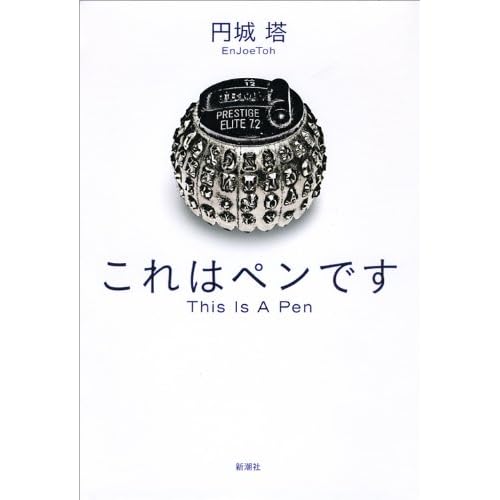
「これはペンです」
"This is a Pen"
I'm not going to lie—I'm a sucker for titles. The description on Amazon is interesting though:
"Uncle is a letter. Literally. A man who invented an automatic sentence generator and his brother who has vivid memories of a town that doesn't exist. A tale of twins that illuminates the origins of reading and writing."
Definitely sounds like something I would want to read. I did a little more research, and found out that "This is a Pen" was a finalist in the Akutagawa Prize earlier this year.
Then shit got real! In a strange instance of serendipity/coincidence/it's-a-small-world-after-all-ism, I actually own two pieces by Enjoe Toh. In the January 2011 issue of Bungakukai, he has a short story called "Magnitude," and he has a story (novella, perhaps, it's very long) in the Best Sci-Fi of 2007 collection "Imaginary Engines," the same collection that contained the 2010 Kurodahan Translation Prize piece "忠告."
Anyway, he sounds like an interesting author. He graduated from Tohoku University studying physics, and then went to Tokyo University for graduate school. Wikipedia doesn't specify him as anything besides a novelist, but he definitely seems to have a sci-fi bent. For instance, another short story title: "The History of the Decline and Fall of the Galactic Empire."
He's had other pieces nominated for the Akutagawa, but he has yet to win it. However he has won the Noma Literary Prize and the Bungakukai New Writer's Prize, and has been nominated for the Gunzo New Writer's Prize and the Yukio Mishima Prize.
I started reading "Magnitude," but it's...confusing. I'm not
even sure I can explain it. It starts by explaining some sort of weird
number theory. Here's a very short, probably poor translation of the
very beginning:
"9
In twenty years, we learn the world approaches ten.
Now is still nine. They say a hundred years ago was eight.
China and India, nine. The entire planet, nine. Only Japan is eight.
Next, they say, decline will begin, and in time, it might be seven. It
was seven a hundred years ago.
I am 0..."
It goes on to explain a very strange theory about zero and it's relationship to other numbers, and how zero is also known as, you guessed it, "magnitude."
I...don't even
know. I plan on spending some more time fighting my way through this
story, but I'm not sure what I'm going to get out of it. "Palimpsest" is quite long, but since I have it, I might as well take a look.
If you want to try reading some Enjoe Toh for yourself, he has a serialized Twitter novel at the username @EnJoe140, separate from his own Twitter account @EnJoeToh. I think it's all done; it hasn't been updated since September 17th.
You can also pick up Kurodahan Press's Speculative Japan 2, which has a translation of Enjoe's story "Freud" (haven't read it, but of course, now I want to).
Enjoe Toh might be a name to look out for in the future.
Showing posts with label journals. Show all posts
Monday, September 26, 2011
Saturday, September 17, 2011
September 2011 Japan Book News
Fall has (basically) arrived and with the changing of the seasons comes a new issue of Japan Book News.
If you don't know, Japan Book News is published quarterly by the Japan Foundation. It's full of articles and news about the current Japanese literary culture, as well as a list of notable new releases. It's a great resource for finding out what books are making a stir in the Japanese literary community.
Volume 69 is now up, but unfortunately, the link to downloading the full PDF of the issue is broken, so you can't read the news and articles just now. They do have links to the summaries of the new releases though, and they've highlighted a couple very interesting seeming books. Here's a look at what I'd be interested in getting my hands on:
(Unfortunately, they use Javascript to link to all their internal pages, so as much as I'd like to, I can't give you a direct link to everything they're talking about. You'll have to go the main page, and click your way through to the index for Volume 69 to see more information about these titles. All links are to Amazon Japan product listings.)
1)雪の練習生 ("The Apprentices of Snow," their translation not mine)
by Yoko Tawada
Yoko Tawada has a number of works out in English. I read The Bridegroom was a Dog a while back, but I just read the short story collection Where Europe Begins put out by New Directions, and now I've become a huge fan. Tawada is so surreal and inventive, and she can manipulate these qualities into something either extremely beautiful or extremely disturbing, sometimes practically instantaneously. She writes in both German and Japanese (Where Europe Begins was mostly her German work), but I'm assuming that she wrote this one in Japanese.
Anyway, it's about polar bears. Not just about polar bears, narrated by polar bears. And not just any polar bears. A polar bear trained for the circus who writes a memoir and becomes a famous writer, for one.
Writing from the point of view of a personified animal seems to be in vogue right now in Japan. Belka, Why Don't You Bark? by Hideo Furukawa follows dogs (I think it's narrated by the dogs but I'm not sure), and Kenshin by Rieko Kawakami is about a woman who is turned into a dog. Either way, interesting premise, great writer—I'd love to see this come out by New Directions, who has published a lot of Tawada in the past.
2) 生首 ("Severed Heads")
by Henmi Yo
There's a pretty robust poetry scene in Japan, some of which gets across the Pacific Ocean. The Best Translated Book Award has always had at least one Japanese poet on their shortlist save their inaugural year. I'm not familiar with Henmi Yo really, but I don't think Japan Book News highlights a lot of poetry, and I do like the little excerpt they put in their description:
One evening in early autumn
Across the darkening blue of the western skies
I watched a severed head fly across the heavens.
Not a lot to go on, but worth checking out I think.
3) 日本語ほど面白いものはない (Nothing is as Fun as Japanese)
by Naoki Yanase
I can't imagine anything like this would EVER get published in English, but it sounds interesting to me all the same. It's based on a series of lectures given by Yanase to a sixth grade class on why Japanese is a cool language. The reason why it's interesting to me is Yanase himself, who did Japanese translations of Roald Dahl and Lewis Carrol, as well as James Joyce's Finnegans Wake. Finnegans fucking Wake! I would LOVE to learn more about this guy.
Hey, and maybe since it's written for sixth graders, it would be pretty easy to read, and it might make a good supplementary textbook for American high school or college students learning Japanese. Maybe there's a market for this book after all.
4) 日本の刺青と英国王室 ("Japanese Tattoos and the British Royal Family")
by Noboru Koyama
Title sort of explains it all. About British Princes in the late 19th century that did some tourism and got some badass tattoos, and then more about the history of Japanese tattooing. I don't read a lot of history books, but this sounds pretty fascinating.
5) 文豪の食卓 (Great Writers at the Dinner Table)
by Tokuzo Miyamoto
OK, this one might appeal to me only. I love food, and I love to read about famous people talking about food. So from what I understand of the description of this book, it's part profiles of famous writers through their documented experiences with food and part exposé about regional Japanese food. It seems like it profiles a lot of French and American writers (though there must be something about Japanese writers). I love this kind of stuff, though I can't imagine it ever being published in translation.
6)近代日本奇想小説史:明治編 (A History of the Japanese Imaginative Novel: Meiji Era)
by Jun'ya Yokota
Another history book, but this one about science fiction, speculative fiction, and other genre fare of the Meiji Era. It's 1200 pages though—I'd never get through it. I'd rather read about the neat stuff No-sword digs up.
There's also a new book by Yuko Tsushima, who I was never a fan of, and a history of Japanese mystery novels, which they hilariously call "much-neglected," cause seriously, what is being translated in America besides mystery/crime/thrillers and Murakami?
Anyway, good selection of cool stuff. Check it out, especially you publishing types if you're out there—let's get some cool stuff translated into English!
If you don't know, Japan Book News is published quarterly by the Japan Foundation. It's full of articles and news about the current Japanese literary culture, as well as a list of notable new releases. It's a great resource for finding out what books are making a stir in the Japanese literary community.
Volume 69 is now up, but unfortunately, the link to downloading the full PDF of the issue is broken, so you can't read the news and articles just now. They do have links to the summaries of the new releases though, and they've highlighted a couple very interesting seeming books. Here's a look at what I'd be interested in getting my hands on:
(Unfortunately, they use Javascript to link to all their internal pages, so as much as I'd like to, I can't give you a direct link to everything they're talking about. You'll have to go the main page, and click your way through to the index for Volume 69 to see more information about these titles. All links are to Amazon Japan product listings.)
1)雪の練習生 ("The Apprentices of Snow," their translation not mine)
by Yoko Tawada
Yoko Tawada has a number of works out in English. I read The Bridegroom was a Dog a while back, but I just read the short story collection Where Europe Begins put out by New Directions, and now I've become a huge fan. Tawada is so surreal and inventive, and she can manipulate these qualities into something either extremely beautiful or extremely disturbing, sometimes practically instantaneously. She writes in both German and Japanese (Where Europe Begins was mostly her German work), but I'm assuming that she wrote this one in Japanese.
Anyway, it's about polar bears. Not just about polar bears, narrated by polar bears. And not just any polar bears. A polar bear trained for the circus who writes a memoir and becomes a famous writer, for one.
Writing from the point of view of a personified animal seems to be in vogue right now in Japan. Belka, Why Don't You Bark? by Hideo Furukawa follows dogs (I think it's narrated by the dogs but I'm not sure), and Kenshin by Rieko Kawakami is about a woman who is turned into a dog. Either way, interesting premise, great writer—I'd love to see this come out by New Directions, who has published a lot of Tawada in the past.
2) 生首 ("Severed Heads")
by Henmi Yo
There's a pretty robust poetry scene in Japan, some of which gets across the Pacific Ocean. The Best Translated Book Award has always had at least one Japanese poet on their shortlist save their inaugural year. I'm not familiar with Henmi Yo really, but I don't think Japan Book News highlights a lot of poetry, and I do like the little excerpt they put in their description:
One evening in early autumn
Across the darkening blue of the western skies
I watched a severed head fly across the heavens.
Not a lot to go on, but worth checking out I think.
3) 日本語ほど面白いものはない (Nothing is as Fun as Japanese)
by Naoki Yanase
I can't imagine anything like this would EVER get published in English, but it sounds interesting to me all the same. It's based on a series of lectures given by Yanase to a sixth grade class on why Japanese is a cool language. The reason why it's interesting to me is Yanase himself, who did Japanese translations of Roald Dahl and Lewis Carrol, as well as James Joyce's Finnegans Wake. Finnegans fucking Wake! I would LOVE to learn more about this guy.
Hey, and maybe since it's written for sixth graders, it would be pretty easy to read, and it might make a good supplementary textbook for American high school or college students learning Japanese. Maybe there's a market for this book after all.
4) 日本の刺青と英国王室 ("Japanese Tattoos and the British Royal Family")
by Noboru Koyama
Title sort of explains it all. About British Princes in the late 19th century that did some tourism and got some badass tattoos, and then more about the history of Japanese tattooing. I don't read a lot of history books, but this sounds pretty fascinating.
5) 文豪の食卓 (Great Writers at the Dinner Table)
by Tokuzo Miyamoto
OK, this one might appeal to me only. I love food, and I love to read about famous people talking about food. So from what I understand of the description of this book, it's part profiles of famous writers through their documented experiences with food and part exposé about regional Japanese food. It seems like it profiles a lot of French and American writers (though there must be something about Japanese writers). I love this kind of stuff, though I can't imagine it ever being published in translation.
6)近代日本奇想小説史:明治編 (A History of the Japanese Imaginative Novel: Meiji Era)
by Jun'ya Yokota
Another history book, but this one about science fiction, speculative fiction, and other genre fare of the Meiji Era. It's 1200 pages though—I'd never get through it. I'd rather read about the neat stuff No-sword digs up.
There's also a new book by Yuko Tsushima, who I was never a fan of, and a history of Japanese mystery novels, which they hilariously call "much-neglected," cause seriously, what is being translated in America besides mystery/crime/thrillers and Murakami?
Anyway, good selection of cool stuff. Check it out, especially you publishing types if you're out there—let's get some cool stuff translated into English!
Saturday, June 11, 2011
The 2011 Kenzaburo Oe Prize - 俺俺
Anyone with a passing interest in Japanese literature probably knows who Kenzaburo Oe is, if only by virtue of being one of only two Japanese to win the Nobel Prize for Literature back in 1994. That doesn't mean you've read him of course; for instance, I only got around to reading him about two years ago. If you haven't, A Personal Matter is quite good, as is The Changeling. The Silent Cry is another book that is cited among his best, though I haven't read that one yet.
Oe is an intensely personal, intensely intellectual, intensely political writer. He's a big issues kind of writer, even when the plot points seem to echo exactly events in his own life. So it's not surprising that the Academy was drawn to Oe as a candidate for the Nobel Prize, since, coincidentally or not, many of the winners are deeply political writers or individuals. So it's also not surprising that in Japan, he has a literary award in his honor. I mean, how much more internationally renowned can you get as a non-English writing author than winning the Nobel Prize?
I found out about the Kenzaburo Oe Award when I was exploring Gunzo a few months ago, since they made the announcement for the 2011 winner in their May issue. (Gunzo reporting it because both Gunzo and the award are run/sponsored by Kodansha.) It was established in honor of both the 100th anniversary of Kodansha being a company and the 50th "writing anniversary" of Kenzaburo Oe (which by the way, how much more perfect could that timing have been??).
Oe alone chooses the winner—the best novel of the past year.
The Kenzaburo Oe Prize winner is supposed to represent the best of the young generation's "literary intellectuals." It has no cash prize, but the work is to be translated into foreign languages for international publication. In the five years this prize has been acted, I don't think a single work has hit American or British bookshelves. Which I suppose isn't too surprising. I don't know the details about who gets to translates it or when or how, but even if it does get translated, I'm sure very few American publishers want to publish heady, "intellectual" novels from Japan. Just manga, sci-fi/fantasy/light novels, Murakami, and crime fiction please!
Partially inspired by Hopeful in Nagoya's recent diving into of Japanese book reviewing, I decided to try and learn more about this latest winner of the Kenzaburo Oe Prize.
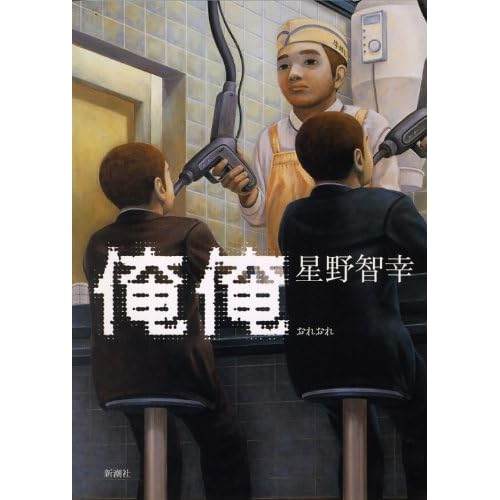
The work is called 俺俺 by 星野智幸, or, Ore Ore by Tomoyuki Hoshino. This title would be hard to translate - it's a repetition of the word "I" or "me," used by dominant, confident, or familiar males, but the title refers to おれおれ詐欺, which is the term for a kind of phone scam. Basically, the perp calls an elderly person and pretends that they are their son or grandson, in order to get them to transfer them money from their bank accounts—basically, they say "Hey, it's me!" and trick their victims into thinking they're family.
Which is the basic premise of this story—a guy, only referred to as 俺, or I, goes to a McDonald's, steals his neighbor's cell phone, and commits a phone scam on this strangers' parents. But it gets stranger. According to the summary on Amazon Japan:
When I took the cell phone of the guy sitting next to me at McDonalds, I ended up committing a phone scam. But then I noticed that I was becoming a different I. The I for my bosses and parents, the I who isn't I, the I who is not I, the we that is I-I [literally: the 俺たち俺俺] So many I's that I don't know what is what anymore. Power off, off. Destroy. Before long, my fellow I's, going this way and that, increasing without end, until… A work that makes the reader ask: What is it, to trust another man, in this age of loneliness and despair?
Weird huh? But vague. So I took a look at the book review from the Asahi newspaper. It begins by repeating the basics of the Amazon summary: "I" goes to a McDonald's, on a whim steals a stranger's cell phone, and tricks the stranger's mother into thinking he was her son, and commits bank transfer fraud. Before he knows it, he starts to became that guy. And gradually, he begins to multiply into other "I"s.
The narrator "I" works at a large electronics store called "Megaton." (Kind of like a Best Buy I assume, perhaps in Akihabara). He seems to feel alienated by his job—even if he took over someone else's duties within the store, his day-to-day affairs wouldn't change. He believes his very existence is "weak", and easily replaceable by someone else. His boss is a mean person "incapable of being understood". The pressure to conform, to not stick out for fear of being made fun of, is overwhelming, and he and his fellow coworkers can barely get by working there. His sense of fitting in at work gets worse and worse, until he organizes a community (perhaps a literal place, like a commune) of "I"s, calling themselves (or the place) "I-Mountain" (俺山):
"At "I Mountain", everyone is I… "I Mountain" is a society without conflict with others. All the hearts of the "I"s are connected" - a transparent community where everyone can be understood. In a place like that, I, as a meaningful existence, is coming to an end. I am becoming no more than a part of a larger self, and the I's always living for each other. That experience is what sustains me."
Suffice it to say that as "I Mountain" starts to get larger, some major problems ensue.
The reviewer starts his/her review simply by calling it a "masterpiece" (傑作). The reviewer says the end took them completely be surprise, and even brought them to tears. The reviewer calls it a "monumental work" of contemporary literature, addressing the problems of identity in modern society.
Although the review seems almost a bit hyperbolic, 「俺俺」 sounds complicated, but awesome. In a strange way, it sort of reminds me of Fight Club, probably due to the weird nameless commune aspects, but it sounds like a fascinating work, one whose message would resonate beyond just Japan but throughout the world. When I have some extra cash I might try to pick it up sometime (it can be ordered from the Kinokuniya website if you live in the US). It's also probably worth checking out the other winners of the Kenzaburo Oe Prize, which you can find a list of, in English, on the Prize's Wikipedia page.
Oe is an intensely personal, intensely intellectual, intensely political writer. He's a big issues kind of writer, even when the plot points seem to echo exactly events in his own life. So it's not surprising that the Academy was drawn to Oe as a candidate for the Nobel Prize, since, coincidentally or not, many of the winners are deeply political writers or individuals. So it's also not surprising that in Japan, he has a literary award in his honor. I mean, how much more internationally renowned can you get as a non-English writing author than winning the Nobel Prize?
I found out about the Kenzaburo Oe Award when I was exploring Gunzo a few months ago, since they made the announcement for the 2011 winner in their May issue. (Gunzo reporting it because both Gunzo and the award are run/sponsored by Kodansha.) It was established in honor of both the 100th anniversary of Kodansha being a company and the 50th "writing anniversary" of Kenzaburo Oe (which by the way, how much more perfect could that timing have been??).
Oe alone chooses the winner—the best novel of the past year.
The Kenzaburo Oe Prize winner is supposed to represent the best of the young generation's "literary intellectuals." It has no cash prize, but the work is to be translated into foreign languages for international publication. In the five years this prize has been acted, I don't think a single work has hit American or British bookshelves. Which I suppose isn't too surprising. I don't know the details about who gets to translates it or when or how, but even if it does get translated, I'm sure very few American publishers want to publish heady, "intellectual" novels from Japan. Just manga, sci-fi/fantasy/light novels, Murakami, and crime fiction please!
Partially inspired by Hopeful in Nagoya's recent diving into of Japanese book reviewing, I decided to try and learn more about this latest winner of the Kenzaburo Oe Prize.
The work is called 俺俺 by 星野智幸, or, Ore Ore by Tomoyuki Hoshino. This title would be hard to translate - it's a repetition of the word "I" or "me," used by dominant, confident, or familiar males, but the title refers to おれおれ詐欺, which is the term for a kind of phone scam. Basically, the perp calls an elderly person and pretends that they are their son or grandson, in order to get them to transfer them money from their bank accounts—basically, they say "Hey, it's me!" and trick their victims into thinking they're family.
Which is the basic premise of this story—a guy, only referred to as 俺, or I, goes to a McDonald's, steals his neighbor's cell phone, and commits a phone scam on this strangers' parents. But it gets stranger. According to the summary on Amazon Japan:
When I took the cell phone of the guy sitting next to me at McDonalds, I ended up committing a phone scam. But then I noticed that I was becoming a different I. The I for my bosses and parents, the I who isn't I, the I who is not I, the we that is I-I [literally: the 俺たち俺俺] So many I's that I don't know what is what anymore. Power off, off. Destroy. Before long, my fellow I's, going this way and that, increasing without end, until… A work that makes the reader ask: What is it, to trust another man, in this age of loneliness and despair?
Weird huh? But vague. So I took a look at the book review from the Asahi newspaper. It begins by repeating the basics of the Amazon summary: "I" goes to a McDonald's, on a whim steals a stranger's cell phone, and tricks the stranger's mother into thinking he was her son, and commits bank transfer fraud. Before he knows it, he starts to became that guy. And gradually, he begins to multiply into other "I"s.
The narrator "I" works at a large electronics store called "Megaton." (Kind of like a Best Buy I assume, perhaps in Akihabara). He seems to feel alienated by his job—even if he took over someone else's duties within the store, his day-to-day affairs wouldn't change. He believes his very existence is "weak", and easily replaceable by someone else. His boss is a mean person "incapable of being understood". The pressure to conform, to not stick out for fear of being made fun of, is overwhelming, and he and his fellow coworkers can barely get by working there. His sense of fitting in at work gets worse and worse, until he organizes a community (perhaps a literal place, like a commune) of "I"s, calling themselves (or the place) "I-Mountain" (俺山):
"At "I Mountain", everyone is I… "I Mountain" is a society without conflict with others. All the hearts of the "I"s are connected" - a transparent community where everyone can be understood. In a place like that, I, as a meaningful existence, is coming to an end. I am becoming no more than a part of a larger self, and the I's always living for each other. That experience is what sustains me."
Suffice it to say that as "I Mountain" starts to get larger, some major problems ensue.
The reviewer starts his/her review simply by calling it a "masterpiece" (傑作). The reviewer says the end took them completely be surprise, and even brought them to tears. The reviewer calls it a "monumental work" of contemporary literature, addressing the problems of identity in modern society.
Although the review seems almost a bit hyperbolic, 「俺俺」 sounds complicated, but awesome. In a strange way, it sort of reminds me of Fight Club, probably due to the weird nameless commune aspects, but it sounds like a fascinating work, one whose message would resonate beyond just Japan but throughout the world. When I have some extra cash I might try to pick it up sometime (it can be ordered from the Kinokuniya website if you live in the US). It's also probably worth checking out the other winners of the Kenzaburo Oe Prize, which you can find a list of, in English, on the Prize's Wikipedia page.
Thursday, June 9, 2011
More on Japanese Literary Journals
A couple months ago I was really getting into the literary journal scene in Japan. It was really only because I got my hands on some recent issues of Bungakukai, but I started looking into Gunzo as well. I did some research, and if you want to stay afloat on the Japanese literary scene but not in Japan yourself, here are some possible means to do so.
I found out you can order Bungakukai through Amazon, which is pretty freaking awesome. The only problem is that it costs $224 for a year's subscription, or twelve issues. A little over 18 bucks an issue, which is not an impossible price (though certainly out of my price range right now), and it is a lot of content—roughly 3600 pages of fiction, poetry, author interviews, and essays.
Even better (though for not nearly as much content) is that I found out that Gunzo has an iPhone/iTouch/iPad "preview" app. It's a best of collection, that includes whole short stories, the first chapters in serialized novels and essays (including one about Murakami in America), poetry, and best of all, it's completely free. Obviously this is only useful for those with an iWhatever, but, it's kind of cool to offer it all for free.
Gunzo and Bungakukai are also on Twitter, where they often announce who is going to be what issue, who has won their big prizes, and retweets people's (favorable) responses to whatever they just published.
It goes without saying that all of these are only useful if you can read Japanese...
[In the next post, I'm going to look at a literary award (and one of it's recipients) that hasn't been mentioned in English yet because it is fairly new and none of the pieces have been translated yet into English - The Kenzaburo Oe Prize.]
I found out you can order Bungakukai through Amazon, which is pretty freaking awesome. The only problem is that it costs $224 for a year's subscription, or twelve issues. A little over 18 bucks an issue, which is not an impossible price (though certainly out of my price range right now), and it is a lot of content—roughly 3600 pages of fiction, poetry, author interviews, and essays.
Even better (though for not nearly as much content) is that I found out that Gunzo has an iPhone/iTouch/iPad "preview" app. It's a best of collection, that includes whole short stories, the first chapters in serialized novels and essays (including one about Murakami in America), poetry, and best of all, it's completely free. Obviously this is only useful for those with an iWhatever, but, it's kind of cool to offer it all for free.
Gunzo and Bungakukai are also on Twitter, where they often announce who is going to be what issue, who has won their big prizes, and retweets people's (favorable) responses to whatever they just published.
It goes without saying that all of these are only useful if you can read Japanese...
[In the next post, I'm going to look at a literary award (and one of it's recipients) that hasn't been mentioned in English yet because it is fairly new and none of the pieces have been translated yet into English - The Kenzaburo Oe Prize.]
Monday, April 25, 2011
Monkey Business: A New Japan-based Literary Journal
Good news, everyone!
Actually, better than that: pretty awesome news.
The literary journal A Public Space is producing an American version of the Japanese literary journal Monkey Business which will highlight contemporary Japanese literature in English translation!
Holy shit! That's great!
[This is all via Three Percent, by the way.]
It's being edited and put together by Motoyuki Shibata, an English translator of contemporary authors like Thomas Pynchon and Paul Auster, and founder of the original Japanese journal Monkey Business, Ted Goosen, a Japanese translator, and Roland Kelts, author of Japanamerica.
And the selection looks amazing. Some highlights include:
Monsters, a short story by Hideo Furukawa (remember how we were talking about Belka, Why Don't You Bark last week?)
translated by Michael Emmerich
People from My Neighborhood: a collection of vignettes by Hiromi Kawakami (author of the recent Manazuru, which I should have a review of up on Three Percent in the next couple weeks)
translated by Ted Goossen
The Tale of the House of Physics: a short story by Yoko Ogawa (author of The Housekeeper and the Professor and Hotel Iris)
translated by Ted Goossen
Pursuing “Growth”: an interview with Haruki Murakami by Hideo Furukawa (Oh how I want to read this...)
translated by Ted Goossen
And tons more, including a lot of poetry, and a manga version of Kafka. You can see the whole table of contents at the A Public Space website.
Not only that, as far as I can tell, this isn't a one time thing. This is just the first issue—although it will only be coming out once a year.
Still, though, I'm extremely pumped. An entire literary journal devoted to Japanese literature? That will come out regularly? Yes and yes. You can order it here, like I already have.
Actually, better than that: pretty awesome news.
The literary journal A Public Space is producing an American version of the Japanese literary journal Monkey Business which will highlight contemporary Japanese literature in English translation!
Holy shit! That's great!
[This is all via Three Percent, by the way.]
It's being edited and put together by Motoyuki Shibata, an English translator of contemporary authors like Thomas Pynchon and Paul Auster, and founder of the original Japanese journal Monkey Business, Ted Goosen, a Japanese translator, and Roland Kelts, author of Japanamerica.
And the selection looks amazing. Some highlights include:
Monsters, a short story by Hideo Furukawa (remember how we were talking about Belka, Why Don't You Bark last week?)
translated by Michael Emmerich
People from My Neighborhood: a collection of vignettes by Hiromi Kawakami (author of the recent Manazuru, which I should have a review of up on Three Percent in the next couple weeks)
translated by Ted Goossen
The Tale of the House of Physics: a short story by Yoko Ogawa (author of The Housekeeper and the Professor and Hotel Iris)
translated by Ted Goossen
Pursuing “Growth”: an interview with Haruki Murakami by Hideo Furukawa (Oh how I want to read this...)
translated by Ted Goossen
And tons more, including a lot of poetry, and a manga version of Kafka. You can see the whole table of contents at the A Public Space website.
Not only that, as far as I can tell, this isn't a one time thing. This is just the first issue—although it will only be coming out once a year.
Still, though, I'm extremely pumped. An entire literary journal devoted to Japanese literature? That will come out regularly? Yes and yes. You can order it here, like I already have.
Wednesday, March 16, 2011
Bungakukai: a Japanese Literary Magazine
Today I got my hands on a number of recent issues of the literary magazine Bungakukai. According to the great and powerful Wikipedia, it is one of the top five most prestigious literary journals of Japan, the others being Gunzo, Shincho, Subaru, and Bungei. I'd only heard of Gunzo before because I've read about Haruki Murakami being published in it.
It is very much like an American literary journal, but a bit larger than the ones I've come across - it's a good 340 pages (for instance, Glimmer Train comes in at a little over 200; Paris Review certainly felt smaller when I held it in my hands at the bookstore a few weeks ago). It has short stories, poetry, serialized parts of longer novels, interviews, and essays. Also, they all have the same type of cover - that of large, scary-looking sculptures of various animals with the same zombie bugged out eyes.
Another cool thing about Bungakukai, especially in comparison to American literary journals, is that it comes out monthly. Not quarterly, or trimester-ly. I have no clue how well these magazines sell or how easy it is find them when in bookstores (I never thought to look for them when I was in Japan) but you would think that they're a bit more popular than our American counterparts.
Here in front of me I have the newest issue, that is, April 2011. There's some interesting stuff here, and a lot of names I recognize. The following is just a small portion of what it has to offer:
Still, pretty neat, yeah? Maybe I'll do this again with some of my other volumes. Let me know if any of you out there are even interested.
It is very much like an American literary journal, but a bit larger than the ones I've come across - it's a good 340 pages (for instance, Glimmer Train comes in at a little over 200; Paris Review certainly felt smaller when I held it in my hands at the bookstore a few weeks ago). It has short stories, poetry, serialized parts of longer novels, interviews, and essays. Also, they all have the same type of cover - that of large, scary-looking sculptures of various animals with the same zombie bugged out eyes.
Another cool thing about Bungakukai, especially in comparison to American literary journals, is that it comes out monthly. Not quarterly, or trimester-ly. I have no clue how well these magazines sell or how easy it is find them when in bookstores (I never thought to look for them when I was in Japan) but you would think that they're a bit more popular than our American counterparts.
Here in front of me I have the newest issue, that is, April 2011. There's some interesting stuff here, and a lot of names I recognize. The following is just a small portion of what it has to offer:
- The "headline" so to speak is a new novel(la?) by Yoshimoto Banana called Juujuu ("Sizzle sizzle") - described as taking place at a steak house in Shitamachi. It's advertised as being 200 pages, but takes up only 60 in the journal - but each page has two columns so maybe that translates to 200 regular, paperback sized pages.
- There's also a part of a serialized novel (part 11) by Masahiko Shimada called 傾国子女Keikokushijo ("Prostitute children"?)
- A conversation between Itoi Shigesato (essayist and Earthbound creator!) and Genichiro Takahashi called (maybe this is not what the Japanese is going for, but it sounds right to me, and also hilarious) "To 'Sayonara', or not to 'Sayonara': 30 Years of Japan and After." Described as: "The first dialogue between two people who together washed away the limelight of the '80s and ran through 30 years of Japan." I think this has something (everything) to do with the live tweet marathon Takahashi did at Itoi's office to promote his latest volume of literary criticism called "Sayonara, Japan: Japanese Novels 2."
Still, pretty neat, yeah? Maybe I'll do this again with some of my other volumes. Let me know if any of you out there are even interested.
Subscribe to:
Posts (Atom)