Well, there's no particular reason for me to write a Best of 2011 list, except for the fact that it's the end of the year and EVERYONE is doing it. Then again, there's no reason NOT for me to do it either.
Though honestly, I read a lot of great books this year. Actually, in general, I just read a lot. I have no records before this year, but I started using Goodreads in January of this year, and I love using it, so I've been very diligent about adding everything I read (to an embarrassing degree, too, since everyone can tell when I totally give up on a book too). As of writing this post, I read 43 books this year, and it'll probably be an even 45 by January 1st—though I know that those two won't end up on this list in the end so I don't mind waiting to write about my Best Of now.
So yes. I've narrowed it down to a top 5, but I also will highlight some honorable mentions as well after. I'll even do a little countdown, because I am a dork. The top 5 all actually came out in 2011, and the honorable mentions will primarily be other great books I read this year but didn't actually come out in 2011. And without further ado:
Will's Best Literature of 2011:
5. Funeral For a Dog
by Thomas Pletzinger
Translated by Ross Benjamin
I read this for a class in Literary Translation right before I graduated, but it's stuck with me for the rest of the year. It's a debut novel, and I think you can tell when you read it. It has a messy, shaggy dog type quality to the prose as well as the construction of the work itself, but it is such a strong voice, and it is amazingly effective.
Basically, it's about a journalist who's sent by his editor/girlfriend to interview a reclusive children's book author. There's a story in a story here too—the journalist discovers a manuscript while staying at the author's lakeside home that tells the story of a love triangle that spans across the globe, and the way these two plot elements dovetail is nothing short of beautiful and heartbreaking at the same time. There's even a little real-life Easter Egg that you can discover, but I'll let you find it for yourself. So yes, three words to describe this book: messy, heartbreaking, beautiful. Just like life, you say? Just like love, you say?
It also reads beautiful (i.e. the translation is amazing) possibly due in part the level of collaboration between the author (who does speak English) and the translator (they're like best friends now). Insider knowledge!
4. Stone Upon Stone
by Wiesław Myśliwski
Translated By Bill Johnston
If anyone from the aforementioned translation class reads this blog (I'm pretty sure they don't), they are sure to yell at me, because I was the only person in class who had anything slightly negative to say about this book when we were reading it.
But let the record show that I declare that I was slightly too hard on it, though I still believe some of my minor criticisms are valid. I was on hard on this book because I had to read this 500+ page monstrosity in about four days, which might have made me a little extra sensitive or cranky.
Though truly, it was not the worst four days I've ever spent (though very tiring). Stone Upon Stone follows a man, building his grave, as he reflects upon his life in rural Poland. But this dude was a boisterous Zorba type fellow—a heavy drinker, a fighter, a lover, a coward, a soldier, a pesky brat. It chronicles both his entire life—elliptically, and in pieces—but it also shows the way Poland modernized starting from around World War II until almost the present day (present when it was written, I believe, which was the mid-1980s).
Look, invisible classmates who aren't here, the main character is awesome. He is hilarious, and his life was very entertaining. However, sometimes I don't appreciate ten pages of solid text when some minor character who won't appear again talks in one large existential monologue about life or farming or whatever, when I still have three hundred pages to read in 48 hours on top of everything else I have to do.
But seriously, this is the kind of ambitious, all-encompassing, total novel that only comes like once a decade, if that. I know absolutely nothing of Polish or Eastern European literature, but I know that this is an "important" novel. It's the kind of greatness that every writer aspires to. And it is like 85% entertaining, which for it's page length is an impressive feat. Stone Upon Stone absolutely needs to be read by anyone who loves serious fiction.
3. There But For The
by Ali Smith
Thinking about this novel right novel, I'm still amazed by the linguistic acrobatics and witticisms. And how moved I was when I reached the end.
The basic plot (there's no such thing, and I keep saying this, and I know in the end I'm going to talk about how much more to it there is than that summary but I can't help myself) is that a quiet man Miles is invited to a dinner party, then locks himself in the guest room and doesn't come out. However, the novel is never told from Miles' POV, but from four other characters that barely know the man in question, like someone who went on a high school trip with him, or the precocious daughter of the family who invited Miles to the dinner. They all only know a little bit about him, and yet Miles becomes this strange but powerful symbol to them all, and they all rally behind him to make sure that he doesn't starve in the room, for instance.
But Ali Smith brings such life to her words, and each of the four characters is so different from each other and linguistically different. And on top of that, each chapter uses a word in the title as it's theme. You'd think it would be hard to write a story using the word "the" as the theme that ties it all together, but Ali Smith not only accomplishes this feat, she freaking excels at it. Mind = still blown.
2. How To Live Safely in a Science Fictional Universe
by Charles Yu
Ok, so I'm cheating a little bit. TECHNICALLY the hardcover of this book came out last year, but the paperback DID come out this year, and that's what I actually read (though I've been wanting to read it since before the paperback came out. I just got lucky I waited long enough that it did). But frankly, this book was so amazing I couldn't not let it on this list.
I'm not sure this book is as technically or stylistically as brilliant as some of the other books on this list, but this one was by far the most entertaining, in a page-turner kind of way. I think it's literary merits are still very high though. It just happens to weave themes like "fiction" vs "reality," the complicated relationships between family, determinism and fate, and the nature of love, with a gripping science-fictional hook.
Again, another novel that has a shaggy dog appeal. The beginning, in particular, has a slightly patchwork quality of little vignettes of what it's like to be a "time travel machine repair man," but when the ball gets rolling it really gets rolling. In that way it reminds me of early Murakami, particularly A Wild Sheep Chase and Hardboiled Wonderland and the End of the World. A Wild Sheep Chase evokes a mood before the plot gets started almost a hundred pages in, a quality this book definitely shares, and it also has HWatEotW's science-fictional/meta-physical plot bent. I fell for this book so hard, like I haven't in a long time. It's messiness keeps it from being a truly great novel, but it's entertainment and thought value brings it way up my list, and I cannot wait to read everything by Charles Yu I can get my hands on.
1. The Private Lives of Trees
by Alejandro Zambra
Translated by Megan McDowell
I had to justify choosing this as my best book of the year for a while.
Not because I don't believe it is truly, truly great. But it is a novella. It's only 90-ish pages. How can I compare this slight little thing with the ambition and scope of Stone Upon Stone or the linguistic games of There But For The or the philosophical/entertainment value of How to Live Safely in a Science Fictional Universe?
Well, I will admit that I love short novels and novellas. I love tight writing. I want every word to be important and perfectly used. And I think this is the closest thing I've ever read to that ideal. Not a single goddamn word is wasted in this thing. And it is so freaking beautiful and moving and resonant. I have never been so affected by the words on a page.
The Private Lives of Trees is about a guy who's telling a bedtime story to his daughter as they wait for her mother to come home. The question is, the guy realizes, is whether the mother ever will come home. And so he thinks. And writes. And tells a story.
In 90 odd pages, we see an entire relationship grow. In 90 pages we get a fully realized father-daughter relationship. We see an entire life in less pages than that. And Zambra has so much style. Brimming with language that just is so evocative. I've never read a writer quite like him.
You can read this in an afternoon. In one sitting. And if you're like me, you'll want to. You'll need to. This novella is amazing. I think everyone should read this.
I'm sure this novella has its critics. In fact, after reading Bonsai, I can see how similar the two works are. So who knows if Zambra has another story in him. But at least we have this one.
Phew. Just thinking about that book makes me want to read it right this second.
Anyway: some honorable mentions, in no particular order:
From 2011:
An Empty Room, by Mu Xin
The Illumination, by Kevin Brockmeier
Not from 2011:
Oblivion, by David Foster Wallace
Bonsai, by Alejandro Zambra
The Literary Conference, by Cesar Aira
Where Europe Ends, by Yoko Tawada
What great books did you all read?
Showing posts with label literature. Show all posts
Showing posts with label literature. Show all posts
Thursday, December 29, 2011


Tuesday, October 4, 2011
Japanese FICTION Bestsellers of 2011 (So Far), Part 1
Our coverage of Japan's bestseller lists continues with a look at the fiction bestsellers of the first half of 2011.
I'm almost tempted to go full car-salesman and just start saying "October is Bestseller Month at Wednesday Afternoon Picnic!!!" but I don't think coverage will quite last that long. Anyway, today we'll be looking at just fiction bestsellers.
Japanese vocabulary time!
Tohan divides up the sales numbers between tankoubon and bunkobon. Now, these do not stand for hardcover and paperback, the way we list our bestsellers (although they are, weirdly, similar, but we'll get to that in a second). They don't even describe the same qualities or standards of comparison.
Tankoubon (単行本)just means a collected or independent volume; it is a complete work. Of course, this word is also illogically used to refer to a single volume in a manga series, believe it or not, to make it extra confusing.
The word bunkobon(文庫本) refers to the size of the book itself, which is similar to our mass-market pocket-sized paperbacks. They are designed, like our mass-market paperbacks, to be super cheap and portable, though they are generally nicer—they get their own dust jackets and everything.
As mentioned above, tankoubon does not refer to the quality of the book itself; however, if you look at the size of any novel on Amazon that's listed as tankoubon, you'll notice the size is usually somewhere around 19cm by 14cm. Which is in fact, just about the size of all the Japanese novels that I own that are indeed, hardcover books. So while it's not necessarily true, today, for all intents and purposes, we can think of tankoubon as the hardcovers and bunkobon as the paperbacks.
Today we look at the tankoubon bestsellers for fiction, according to Tohan:
1) 謎解きはディナーのあとで ("The Riddle Will Be Solved After Dinner")
by Higashigawa Tokuya
2 )KAGEROU
by Satohiro Saito
3) くじけないで ("Don't Be Discouraged")
by Shibata Toyo
4) 麒麟の翼 ("Wings of the Qilin")
by Higashino Keigo
5) 放課後はミステリーとともに ("After School Will Be With Mysteries")
by Higashigawa Tokuya
6) 傾物語 ("Twisted Tales")
by Nishio Isin
7) 花物語 ("Flower Tales")
by Nishio Isin
8) 江 姫たちの戦国 ("The Bay: The Princess' Warring States")
by Tabuchi Kumiko
9) 苦役列車 ("Train of Suffering")
by Nishimura Kenta
10) 県庁おもてなし課 ("The Prefectural Hospitality Division")
by Arikawa Hiro
The first three on the list should be familiar from last time, so I won't go into any more detail about them. Some comments about the rest of the list:
4) Higashino Keigo is way more popular than he has any right to be. He's like the James Patterson of Japan—anything he writes seems to turn to gold (though thankfully he is not so prolific). I read MOST of Naoko which was put out by Vertical because I thought it had a great sounding premise, but couldn't finish it because it was such garbage...at least in my opinion. Your mileage may vary. You can also try reading The Devotion of Suspect X which was put out by Minotaur. "Wings of the Qilin" (qilin is the Chinese unicorn, way more bad-ass than the Western unicorn) is another murder mystery. Amazon's description is very generic. That's all I have to say.
5) Another mystery story by the author of the number one bestseller "The Riddle Will Be Solved After Dinner." There's a school, and they have a detective club, and for some reason there are a lot of crimes for them to solve. This has also been turned into a movie (although it looks like it was a web series that then had a special in-movie-theaters showing).
6 and 7) Nisio Isin (not spelled the standard Ishin because his name is a palindrome) is a very popular light novel (basically young adult fiction with some illustrations, kind of a compromise between manga and literature) author. These two books are the latest installments of his "Monogatari" series. The series, under the name Bakemonogatari, has recently become a fairly popular anime series.
8) Again, it's because of a TV adaptation that this series (it's actually in three parts) seems to be on the list. It's the latest Taiga drama to be broadcasted on NHK. It's historical fiction. If you're interested in a summary, you can check out the big long Wikipedia article about it. (Sidenote: it stars Nodame Cantabile's live-action Nodame, Ueno Juri, so I imagine as an actress this is a pretty big deal for her and her fans).
9) I recognized this title as a book recommended in the last issue of Japan Book News. Unfortunately, I did not mention it in my write-up of said issue because I thought it looked mega-boring. It might be on the bestseller list because it did win the last Akutagawa Prize, which is a pretty big deal...though the description on Japan Book News can't help but be surprised that this work is a bestseller either. But plotwise...
Written in the form of an I-novel (basically a confessional, thinly-veiled autobiographical work written in the first person), it's about a guy who drops out of school, has some shitty backbreaking jobs, the money of which he squanders on booze and prostitutes... I don't know why I'm so cynical about this work (or rather, the idea of it, I guess). I'm deeply suspicious of any work that uses such bleakness as shock value in lieu of deeper thematic content. And that might not be the case for this novel. But guilty until proven innocent, for me.
10) Arikawa Hiro is another wildly successful light novelist. If you're an anime fan, you might be familiar with her work through the anime adaptation of Toshokan Sensou ("Library Wars"). It's supposedly about a young government worker struggling between bureaucratic red tape and the will of the private citizen as they start their new job assisting a popular local writer...but it's also a story that simultaneously is, you know, interesting to teenagers.
Some parallels are starting to emerge regarding Japanese and American reading habits. I think what we can all take home is that both cultures love:
1) Mysteries and thrillers (and a general darkness in content and tone).
2) Books that are "inspiring" and more about the person behind the book than the book itself (in the case of 100-year old Toyo Shibata and her poetry), see books like this or this.
3) Serialized young adult fiction that easily adapts to non-book entertainment.
Next time, mass-market paperback fiction (bunkobun)!
I'm almost tempted to go full car-salesman and just start saying "October is Bestseller Month at Wednesday Afternoon Picnic!!!" but I don't think coverage will quite last that long. Anyway, today we'll be looking at just fiction bestsellers.
Japanese vocabulary time!
Tohan divides up the sales numbers between tankoubon and bunkobon. Now, these do not stand for hardcover and paperback, the way we list our bestsellers (although they are, weirdly, similar, but we'll get to that in a second). They don't even describe the same qualities or standards of comparison.
Tankoubon (単行本)just means a collected or independent volume; it is a complete work. Of course, this word is also illogically used to refer to a single volume in a manga series, believe it or not, to make it extra confusing.
The word bunkobon(文庫本) refers to the size of the book itself, which is similar to our mass-market pocket-sized paperbacks. They are designed, like our mass-market paperbacks, to be super cheap and portable, though they are generally nicer—they get their own dust jackets and everything.
As mentioned above, tankoubon does not refer to the quality of the book itself; however, if you look at the size of any novel on Amazon that's listed as tankoubon, you'll notice the size is usually somewhere around 19cm by 14cm. Which is in fact, just about the size of all the Japanese novels that I own that are indeed, hardcover books. So while it's not necessarily true, today, for all intents and purposes, we can think of tankoubon as the hardcovers and bunkobon as the paperbacks.
Today we look at the tankoubon bestsellers for fiction, according to Tohan:
1) 謎解きはディナーのあとで ("The Riddle Will Be Solved After Dinner")
by Higashigawa Tokuya
2 )KAGEROU
by Satohiro Saito
3) くじけないで ("Don't Be Discouraged")
by Shibata Toyo
4) 麒麟の翼 ("Wings of the Qilin")
by Higashino Keigo
5) 放課後はミステリーとともに ("After School Will Be With Mysteries")
by Higashigawa Tokuya
6) 傾物語 ("Twisted Tales")
by Nishio Isin
7) 花物語 ("Flower Tales")
by Nishio Isin
8) 江 姫たちの戦国 ("The Bay: The Princess' Warring States")
by Tabuchi Kumiko
9) 苦役列車 ("Train of Suffering")
by Nishimura Kenta
10) 県庁おもてなし課 ("The Prefectural Hospitality Division")
by Arikawa Hiro
The first three on the list should be familiar from last time, so I won't go into any more detail about them. Some comments about the rest of the list:
4) Higashino Keigo is way more popular than he has any right to be. He's like the James Patterson of Japan—anything he writes seems to turn to gold (though thankfully he is not so prolific). I read MOST of Naoko which was put out by Vertical because I thought it had a great sounding premise, but couldn't finish it because it was such garbage...at least in my opinion. Your mileage may vary. You can also try reading The Devotion of Suspect X which was put out by Minotaur. "Wings of the Qilin" (qilin is the Chinese unicorn, way more bad-ass than the Western unicorn) is another murder mystery. Amazon's description is very generic. That's all I have to say.
5) Another mystery story by the author of the number one bestseller "The Riddle Will Be Solved After Dinner." There's a school, and they have a detective club, and for some reason there are a lot of crimes for them to solve. This has also been turned into a movie (although it looks like it was a web series that then had a special in-movie-theaters showing).
6 and 7) Nisio Isin (not spelled the standard Ishin because his name is a palindrome) is a very popular light novel (basically young adult fiction with some illustrations, kind of a compromise between manga and literature) author. These two books are the latest installments of his "Monogatari" series. The series, under the name Bakemonogatari, has recently become a fairly popular anime series.
8) Again, it's because of a TV adaptation that this series (it's actually in three parts) seems to be on the list. It's the latest Taiga drama to be broadcasted on NHK. It's historical fiction. If you're interested in a summary, you can check out the big long Wikipedia article about it. (Sidenote: it stars Nodame Cantabile's live-action Nodame, Ueno Juri, so I imagine as an actress this is a pretty big deal for her and her fans).
9) I recognized this title as a book recommended in the last issue of Japan Book News. Unfortunately, I did not mention it in my write-up of said issue because I thought it looked mega-boring. It might be on the bestseller list because it did win the last Akutagawa Prize, which is a pretty big deal...though the description on Japan Book News can't help but be surprised that this work is a bestseller either. But plotwise...
Written in the form of an I-novel (basically a confessional, thinly-veiled autobiographical work written in the first person), it's about a guy who drops out of school, has some shitty backbreaking jobs, the money of which he squanders on booze and prostitutes... I don't know why I'm so cynical about this work (or rather, the idea of it, I guess). I'm deeply suspicious of any work that uses such bleakness as shock value in lieu of deeper thematic content. And that might not be the case for this novel. But guilty until proven innocent, for me.
10) Arikawa Hiro is another wildly successful light novelist. If you're an anime fan, you might be familiar with her work through the anime adaptation of Toshokan Sensou ("Library Wars"). It's supposedly about a young government worker struggling between bureaucratic red tape and the will of the private citizen as they start their new job assisting a popular local writer...but it's also a story that simultaneously is, you know, interesting to teenagers.
Some parallels are starting to emerge regarding Japanese and American reading habits. I think what we can all take home is that both cultures love:
1) Mysteries and thrillers (and a general darkness in content and tone).
2) Books that are "inspiring" and more about the person behind the book than the book itself (in the case of 100-year old Toyo Shibata and her poetry), see books like this or this.
3) Serialized young adult fiction that easily adapts to non-book entertainment.
Next time, mass-market paperback fiction (bunkobun)!
Saturday, October 1, 2011
Japanese Bestsellers of 2011 (So Far)
Besides being a depository for my various attempts at translation, one of the aims of this blog has been to report the going-ons of contemporary Japanese literary culture. I get to do this occasionally by reporting on Japanese literature from the perspective of what is happening, or might be happening, here in the United States—potential releases, book reviews, American publishing companies and their translations, etc. But I fear I don't do it that often with what's going on directly in Japan. Every now and then I do, but I realized I've been missing (perhaps ignoring) the most obvious indicator of literary trends: the bestseller lists.
The reason I parenthetically say ignoring is because when I do think to check the bestseller lists, I find it kind of boring—or worse, depressing. Bestselling does not always indicate quality. This week's New York Times Bestseller list, for example, includes eight interchangeable thrillers in the top ten. And The Help. Not to be snooty about my reading habits, but no thank you.
But, I am genuinely curious to see what the Japanese are reading, even if it won't be my literary cup of tea, and luckily, Tohan has data for the top selling books of the first half of 2011.
Let us take a look-see:
In the everything-list, which has both fiction and non-fiction titles put together, there are only three novels in the top ten books, however, they are at least, the very top three.
In first place is 謎解きはディナーのあとで, "The Riddle Will Be Solved After Dinner," by Higashigawa Tokuya. It won the Bookseller's Prize (chosen by people who work at bookstores, but it's basically a popularity prize), and it's described as a collection of six mysteries solved by a lady detective and her "sharp-tongued butler." Ooooh.
If you check out the novel's Amazon listing, it, amazingly, awesomely, has a 2 out of 5 star rating, with a sizable majority of 156 people giving it only one star. Choice review quotes: "A disappointment," and "It's a mystery why this garbage sells so well."
But of course, it's still so popular it's going to become a TV show.
In second place is the non-stop stales behemoth もし高校野球の女子マネージャーがドラッカーの『マネジメント』を読んだら, "What if a High School Baseball Club's Girl Manager Read 'Management' by Drucker?" by Iwasaki Natsumi. (Yes, this is a novel.) This was already a bestseller when I was in Japan a year and a half ago. For more information about this one, check out my friend hopeful in nagoya's write up about the book, and the anime and movie it spawned, as the most strangely-titled yet wildly successful pop culture juggernaut in recent memory.
In third place is KAGEROU, which means both "may-fly" and "ephemera," by Satohiro Saito, also known as Hiro Mizushima, a relatively famous TV actor. This is another one that somehow has both an award, this time the Poplar Fiction Prize, and a terrible Amazon ranking, this time a 2.5 out of 5. It's about a deeply in debt dude who gets downsized and tries to kill himself, only to be stopped by a man in a black suit, who offers him an escape from his money troubles by working for his underground organ donation "company." BUT IS EVERYTHING AS GOOD AS IT SEEMS?
Finally, in bonus fifth place, is granny Toyo Shibata's collection of poetry くじけないで, which we've totally talked about you guys!
Just so you know, three of the remaining five spots are occupied by various Monster Hunter guides (positions 6, 7, and 10). 4th place is 老いの才覚, "A Plan for the Elderly," about what to do with the huge elderly population of Japan, 8th place is a self-help book (do you really care about the title? Fine, it's 心を整える。勝利をたぐり寄せるための56の習慣, "Re-Arrange Your Heart: 56 Habits to Reel In Success") and 9th place is 救世の法: 信仰と未来社会, "The Law of Salvation: Faith and Our Future Society." I imagine the content is self-explanatory.
Next time, I'll take a look at the actual fiction hardcover and paperback bestseller lists for the first half of this year. Then, in the next week or so, I'll take a look at that current week's bestsellers.
The reason I parenthetically say ignoring is because when I do think to check the bestseller lists, I find it kind of boring—or worse, depressing. Bestselling does not always indicate quality. This week's New York Times Bestseller list, for example, includes eight interchangeable thrillers in the top ten. And The Help. Not to be snooty about my reading habits, but no thank you.
But, I am genuinely curious to see what the Japanese are reading, even if it won't be my literary cup of tea, and luckily, Tohan has data for the top selling books of the first half of 2011.
Let us take a look-see:
In the everything-list, which has both fiction and non-fiction titles put together, there are only three novels in the top ten books, however, they are at least, the very top three.
In first place is 謎解きはディナーのあとで, "The Riddle Will Be Solved After Dinner," by Higashigawa Tokuya. It won the Bookseller's Prize (chosen by people who work at bookstores, but it's basically a popularity prize), and it's described as a collection of six mysteries solved by a lady detective and her "sharp-tongued butler." Ooooh.
If you check out the novel's Amazon listing, it, amazingly, awesomely, has a 2 out of 5 star rating, with a sizable majority of 156 people giving it only one star. Choice review quotes: "A disappointment," and "It's a mystery why this garbage sells so well."
But of course, it's still so popular it's going to become a TV show.
In second place is the non-stop stales behemoth もし高校野球の女子マネージャーがドラッカーの『マネジメント』を読んだら, "What if a High School Baseball Club's Girl Manager Read 'Management' by Drucker?" by Iwasaki Natsumi. (Yes, this is a novel.) This was already a bestseller when I was in Japan a year and a half ago. For more information about this one, check out my friend hopeful in nagoya's write up about the book, and the anime and movie it spawned, as the most strangely-titled yet wildly successful pop culture juggernaut in recent memory.
In third place is KAGEROU, which means both "may-fly" and "ephemera," by Satohiro Saito, also known as Hiro Mizushima, a relatively famous TV actor. This is another one that somehow has both an award, this time the Poplar Fiction Prize, and a terrible Amazon ranking, this time a 2.5 out of 5. It's about a deeply in debt dude who gets downsized and tries to kill himself, only to be stopped by a man in a black suit, who offers him an escape from his money troubles by working for his underground organ donation "company." BUT IS EVERYTHING AS GOOD AS IT SEEMS?
Finally, in bonus fifth place, is granny Toyo Shibata's collection of poetry くじけないで, which we've totally talked about you guys!
Just so you know, three of the remaining five spots are occupied by various Monster Hunter guides (positions 6, 7, and 10). 4th place is 老いの才覚, "A Plan for the Elderly," about what to do with the huge elderly population of Japan, 8th place is a self-help book (do you really care about the title? Fine, it's 心を整える。勝利をたぐり寄せるための56の習慣, "Re-Arrange Your Heart: 56 Habits to Reel In Success") and 9th place is 救世の法: 信仰と未来社会, "The Law of Salvation: Faith and Our Future Society." I imagine the content is self-explanatory.
Next time, I'll take a look at the actual fiction hardcover and paperback bestseller lists for the first half of this year. Then, in the next week or so, I'll take a look at that current week's bestsellers.
Monday, September 26, 2011
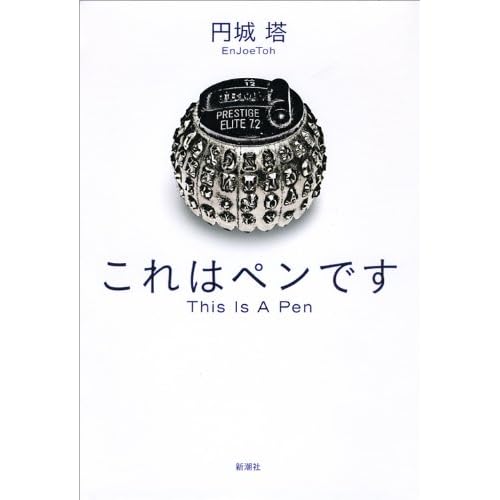
Interesting Author Spotlight: 円城塔 (Enjoe Toh)
I came across this author by chance. I was looking through the Shinchou literary magazine's Twitter feed and noticed it mentioning a book that I thought had a very interesting title:
「これはペンです」
"This is a Pen"
 I'm not going to lie—I'm a sucker for titles. The description on Amazon is interesting though:
"Uncle is a letter. Literally. A man who invented an automatic sentence generator and his brother who has vivid memories of a town that doesn't exist. A tale of twins that illuminates the origins of reading and writing."
Definitely sounds like something I would want to read. I did a little more research, and found out that "This is a Pen" was a finalist in the Akutagawa Prize earlier this year.
Then shit got real! In a strange instance of serendipity/coincidence/it's-a-small-world-after-all-ism, I actually own two pieces by Enjoe Toh. In the January 2011 issue of Bungakukai, he has a short story called "Magnitude," and he has a story (novella, perhaps, it's very long) in the Best Sci-Fi of 2007 collection "Imaginary Engines," the same collection that contained the 2010 Kurodahan Translation Prize piece "忠告."
Anyway, he sounds like an interesting author. He graduated from Tohoku University studying physics, and then went to Tokyo University for graduate school. Wikipedia doesn't specify him as anything besides a novelist, but he definitely seems to have a sci-fi bent. For instance, another short story title: "The History of the Decline and Fall of the Galactic Empire."
He's had other pieces nominated for the Akutagawa, but he has yet to win it. However he has won the Noma Literary Prize and the Bungakukai New Writer's Prize, and has been nominated for the Gunzo New Writer's Prize and the Yukio Mishima Prize.
I started reading "Magnitude," but it's...confusing. I'm not even sure I can explain it. It starts by explaining some sort of weird number theory. Here's a very short, probably poor translation of the very beginning:
"9
In twenty years, we learn the world approaches ten.
Now is still nine. They say a hundred years ago was eight. China and India, nine. The entire planet, nine. Only Japan is eight. Next, they say, decline will begin, and in time, it might be seven. It was seven a hundred years ago.
I am 0..."
It goes on to explain a very strange theory about zero and it's relationship to other numbers, and how zero is also known as, you guessed it, "magnitude."
I...don't even know. I plan on spending some more time fighting my way through this story, but I'm not sure what I'm going to get out of it. "Palimpsest" is quite long, but since I have it, I might as well take a look.
If you want to try reading some Enjoe Toh for yourself, he has a serialized Twitter novel at the username @EnJoe140, separate from his own Twitter account @EnJoeToh. I think it's all done; it hasn't been updated since September 17th.
You can also pick up Kurodahan Press's Speculative Japan 2, which has a translation of Enjoe's story "Freud" (haven't read it, but of course, now I want to).
Enjoe Toh might be a name to look out for in the future.
「これはペンです」
"This is a Pen"
"Uncle is a letter. Literally. A man who invented an automatic sentence generator and his brother who has vivid memories of a town that doesn't exist. A tale of twins that illuminates the origins of reading and writing."
Definitely sounds like something I would want to read. I did a little more research, and found out that "This is a Pen" was a finalist in the Akutagawa Prize earlier this year.
Then shit got real! In a strange instance of serendipity/coincidence/it's-a-small-world-after-all-ism, I actually own two pieces by Enjoe Toh. In the January 2011 issue of Bungakukai, he has a short story called "Magnitude," and he has a story (novella, perhaps, it's very long) in the Best Sci-Fi of 2007 collection "Imaginary Engines," the same collection that contained the 2010 Kurodahan Translation Prize piece "忠告."
Anyway, he sounds like an interesting author. He graduated from Tohoku University studying physics, and then went to Tokyo University for graduate school. Wikipedia doesn't specify him as anything besides a novelist, but he definitely seems to have a sci-fi bent. For instance, another short story title: "The History of the Decline and Fall of the Galactic Empire."
He's had other pieces nominated for the Akutagawa, but he has yet to win it. However he has won the Noma Literary Prize and the Bungakukai New Writer's Prize, and has been nominated for the Gunzo New Writer's Prize and the Yukio Mishima Prize.
I started reading "Magnitude," but it's...confusing. I'm not even sure I can explain it. It starts by explaining some sort of weird number theory. Here's a very short, probably poor translation of the very beginning:
"9
In twenty years, we learn the world approaches ten.
Now is still nine. They say a hundred years ago was eight. China and India, nine. The entire planet, nine. Only Japan is eight. Next, they say, decline will begin, and in time, it might be seven. It was seven a hundred years ago.
I am 0..."
It goes on to explain a very strange theory about zero and it's relationship to other numbers, and how zero is also known as, you guessed it, "magnitude."
I...don't even know. I plan on spending some more time fighting my way through this story, but I'm not sure what I'm going to get out of it. "Palimpsest" is quite long, but since I have it, I might as well take a look.
If you want to try reading some Enjoe Toh for yourself, he has a serialized Twitter novel at the username @EnJoe140, separate from his own Twitter account @EnJoeToh. I think it's all done; it hasn't been updated since September 17th.
You can also pick up Kurodahan Press's Speculative Japan 2, which has a translation of Enjoe's story "Freud" (haven't read it, but of course, now I want to).
Enjoe Toh might be a name to look out for in the future.
Saturday, September 17, 2011
September 2011 Japan Book News
Fall has (basically) arrived and with the changing of the seasons comes a new issue of Japan Book News.
If you don't know, Japan Book News is published quarterly by the Japan Foundation. It's full of articles and news about the current Japanese literary culture, as well as a list of notable new releases. It's a great resource for finding out what books are making a stir in the Japanese literary community.
Volume 69 is now up, but unfortunately, the link to downloading the full PDF of the issue is broken, so you can't read the news and articles just now. They do have links to the summaries of the new releases though, and they've highlighted a couple very interesting seeming books. Here's a look at what I'd be interested in getting my hands on:
(Unfortunately, they use Javascript to link to all their internal pages, so as much as I'd like to, I can't give you a direct link to everything they're talking about. You'll have to go the main page, and click your way through to the index for Volume 69 to see more information about these titles. All links are to Amazon Japan product listings.)
1)雪の練習生 ("The Apprentices of Snow," their translation not mine)
by Yoko Tawada
Yoko Tawada has a number of works out in English. I read The Bridegroom was a Dog a while back, but I just read the short story collection Where Europe Begins put out by New Directions, and now I've become a huge fan. Tawada is so surreal and inventive, and she can manipulate these qualities into something either extremely beautiful or extremely disturbing, sometimes practically instantaneously. She writes in both German and Japanese (Where Europe Begins was mostly her German work), but I'm assuming that she wrote this one in Japanese.
Anyway, it's about polar bears. Not just about polar bears, narrated by polar bears. And not just any polar bears. A polar bear trained for the circus who writes a memoir and becomes a famous writer, for one.
Writing from the point of view of a personified animal seems to be in vogue right now in Japan. Belka, Why Don't You Bark? by Hideo Furukawa follows dogs (I think it's narrated by the dogs but I'm not sure), and Kenshin by Rieko Kawakami is about a woman who is turned into a dog. Either way, interesting premise, great writer—I'd love to see this come out by New Directions, who has published a lot of Tawada in the past.
2) 生首 ("Severed Heads")
by Henmi Yo
There's a pretty robust poetry scene in Japan, some of which gets across the Pacific Ocean. The Best Translated Book Award has always had at least one Japanese poet on their shortlist save their inaugural year. I'm not familiar with Henmi Yo really, but I don't think Japan Book News highlights a lot of poetry, and I do like the little excerpt they put in their description:
One evening in early autumn
Across the darkening blue of the western skies
I watched a severed head fly across the heavens.
Not a lot to go on, but worth checking out I think.
3) 日本語ほど面白いものはない (Nothing is as Fun as Japanese)
by Naoki Yanase
I can't imagine anything like this would EVER get published in English, but it sounds interesting to me all the same. It's based on a series of lectures given by Yanase to a sixth grade class on why Japanese is a cool language. The reason why it's interesting to me is Yanase himself, who did Japanese translations of Roald Dahl and Lewis Carrol, as well as James Joyce's Finnegans Wake. Finnegans fucking Wake! I would LOVE to learn more about this guy.
Hey, and maybe since it's written for sixth graders, it would be pretty easy to read, and it might make a good supplementary textbook for American high school or college students learning Japanese. Maybe there's a market for this book after all.
4) 日本の刺青と英国王室 ("Japanese Tattoos and the British Royal Family")
by Noboru Koyama
Title sort of explains it all. About British Princes in the late 19th century that did some tourism and got some badass tattoos, and then more about the history of Japanese tattooing. I don't read a lot of history books, but this sounds pretty fascinating.
5) 文豪の食卓 (Great Writers at the Dinner Table)
by Tokuzo Miyamoto
OK, this one might appeal to me only. I love food, and I love to read about famous people talking about food. So from what I understand of the description of this book, it's part profiles of famous writers through their documented experiences with food and part exposé about regional Japanese food. It seems like it profiles a lot of French and American writers (though there must be something about Japanese writers). I love this kind of stuff, though I can't imagine it ever being published in translation.
6)近代日本奇想小説史:明治編 (A History of the Japanese Imaginative Novel: Meiji Era)
by Jun'ya Yokota
Another history book, but this one about science fiction, speculative fiction, and other genre fare of the Meiji Era. It's 1200 pages though—I'd never get through it. I'd rather read about the neat stuff No-sword digs up.
There's also a new book by Yuko Tsushima, who I was never a fan of, and a history of Japanese mystery novels, which they hilariously call "much-neglected," cause seriously, what is being translated in America besides mystery/crime/thrillers and Murakami?
Anyway, good selection of cool stuff. Check it out, especially you publishing types if you're out there—let's get some cool stuff translated into English!
If you don't know, Japan Book News is published quarterly by the Japan Foundation. It's full of articles and news about the current Japanese literary culture, as well as a list of notable new releases. It's a great resource for finding out what books are making a stir in the Japanese literary community.
Volume 69 is now up, but unfortunately, the link to downloading the full PDF of the issue is broken, so you can't read the news and articles just now. They do have links to the summaries of the new releases though, and they've highlighted a couple very interesting seeming books. Here's a look at what I'd be interested in getting my hands on:
(Unfortunately, they use Javascript to link to all their internal pages, so as much as I'd like to, I can't give you a direct link to everything they're talking about. You'll have to go the main page, and click your way through to the index for Volume 69 to see more information about these titles. All links are to Amazon Japan product listings.)
1)雪の練習生 ("The Apprentices of Snow," their translation not mine)
by Yoko Tawada
Yoko Tawada has a number of works out in English. I read The Bridegroom was a Dog a while back, but I just read the short story collection Where Europe Begins put out by New Directions, and now I've become a huge fan. Tawada is so surreal and inventive, and she can manipulate these qualities into something either extremely beautiful or extremely disturbing, sometimes practically instantaneously. She writes in both German and Japanese (Where Europe Begins was mostly her German work), but I'm assuming that she wrote this one in Japanese.
Anyway, it's about polar bears. Not just about polar bears, narrated by polar bears. And not just any polar bears. A polar bear trained for the circus who writes a memoir and becomes a famous writer, for one.
Writing from the point of view of a personified animal seems to be in vogue right now in Japan. Belka, Why Don't You Bark? by Hideo Furukawa follows dogs (I think it's narrated by the dogs but I'm not sure), and Kenshin by Rieko Kawakami is about a woman who is turned into a dog. Either way, interesting premise, great writer—I'd love to see this come out by New Directions, who has published a lot of Tawada in the past.
2) 生首 ("Severed Heads")
by Henmi Yo
There's a pretty robust poetry scene in Japan, some of which gets across the Pacific Ocean. The Best Translated Book Award has always had at least one Japanese poet on their shortlist save their inaugural year. I'm not familiar with Henmi Yo really, but I don't think Japan Book News highlights a lot of poetry, and I do like the little excerpt they put in their description:
One evening in early autumn
Across the darkening blue of the western skies
I watched a severed head fly across the heavens.
Not a lot to go on, but worth checking out I think.
3) 日本語ほど面白いものはない (Nothing is as Fun as Japanese)
by Naoki Yanase
I can't imagine anything like this would EVER get published in English, but it sounds interesting to me all the same. It's based on a series of lectures given by Yanase to a sixth grade class on why Japanese is a cool language. The reason why it's interesting to me is Yanase himself, who did Japanese translations of Roald Dahl and Lewis Carrol, as well as James Joyce's Finnegans Wake. Finnegans fucking Wake! I would LOVE to learn more about this guy.
Hey, and maybe since it's written for sixth graders, it would be pretty easy to read, and it might make a good supplementary textbook for American high school or college students learning Japanese. Maybe there's a market for this book after all.
4) 日本の刺青と英国王室 ("Japanese Tattoos and the British Royal Family")
by Noboru Koyama
Title sort of explains it all. About British Princes in the late 19th century that did some tourism and got some badass tattoos, and then more about the history of Japanese tattooing. I don't read a lot of history books, but this sounds pretty fascinating.
5) 文豪の食卓 (Great Writers at the Dinner Table)
by Tokuzo Miyamoto
OK, this one might appeal to me only. I love food, and I love to read about famous people talking about food. So from what I understand of the description of this book, it's part profiles of famous writers through their documented experiences with food and part exposé about regional Japanese food. It seems like it profiles a lot of French and American writers (though there must be something about Japanese writers). I love this kind of stuff, though I can't imagine it ever being published in translation.
6)近代日本奇想小説史:明治編 (A History of the Japanese Imaginative Novel: Meiji Era)
by Jun'ya Yokota
Another history book, but this one about science fiction, speculative fiction, and other genre fare of the Meiji Era. It's 1200 pages though—I'd never get through it. I'd rather read about the neat stuff No-sword digs up.
There's also a new book by Yuko Tsushima, who I was never a fan of, and a history of Japanese mystery novels, which they hilariously call "much-neglected," cause seriously, what is being translated in America besides mystery/crime/thrillers and Murakami?
Anyway, good selection of cool stuff. Check it out, especially you publishing types if you're out there—let's get some cool stuff translated into English!
Saturday, August 6, 2011
Recently Read Round-Up, July 2011
I think I'm going to try making the RRR a monthly thing. I get to highlight a number of interesting books, without the undertaking being too large that I end up putting it off indefinitely. I'm saying this entry is for "July" but in truth it also covers the last third or so of June. If I get good at these round-ups and more ambitious I won't lean so heavily on what I've already written on Goodreads, and make it more of a capsule review type thing. The headline still includes "literature" underneath Wednesday Afternoon Picnic, so I hope the expansion into non-Japanese literature reviews will still be welcome to you all.
Again, you can find me on Goodreads here, to follow in real-time (Oh my gosh so exciting!) what I'm reading.
Seventeen and J: Two Novels, Kenzaburo Oe
Translated by Luk Van Haute

2 out of 5 stars
Although Oe often uses these themes in his body of work, the two novels (said designation being extremely generous; they're novellas, really) gathered here are connected by the themes of politics and sexual perversion. And I'm sure at the time, when Oe was young and with not a lot of work to his name, these two pieces were quite extraordinary in a Ooh-look-at-this-literary-wunderkind-so-much-talent-for-his-age kind of way. But now that we know what Oe's work would become with time and practice, the novellas here are quite lackluster, frankly. Oe at his best uses extreme elements with a light touch, grace, nuance, what have you. Nuance is the last thing on display in these novellas.
Seventeen is about a masturbating (seriously, the narrator is constantly talking about and/or doing it), self-loathing teenager who becomes a member of the youth nationalist movement. It's a straw-man argument, basically, associating this totally hateful, pitiful character with conservative politics, and Oe's fiercely leftist tendencies are so obvious and hamfisted he got death threats and harassment from said right party for Seventeen and it's sequel (which, as noted in this book's introduction, Oe refuses to have translated out of legitimate fear from the response he got publishing it in the first place). J is almost two completely separate stories linked by one character, the first about J's wife shooting her art film with a bunch of their mutual friends/sexual conquests, and the next taking place sometime in the future and follows J as he helps induct a young ward in the ways of being a chikan, men who sexually harass women on the train.
Both deal with some heavy, twisted stuff but Oe doesn't know how to handle them really—it feels like he's writing purely for shock value, to illustrate/tie thematically to whatever he wants to complain about in the state of affairs of Japan. Oe is an unbridled idealist in these works, and they exist purely to pummel you into a conceptual submission. Seventeen and J are interesting from a historical perspective, seeing evolution in Oe's writing and the effects these incendiary works would have on the public, and then back to him, but they're not the best literature. Oe is capable of much better.
Mist, Miguel de Unamuno
Translated by Warner Fite

4 out of 5 stars
The original nivolla (you'll understand this term if you read the book). This book was recommended to me by a translator/student friend who workshopped a translation she did of Unamuno. I loved the short story she translated, and she suggested I read this novel for more.
Mist has a whisper-thin plot—man falls in love with a woman who's in love with someone else sort of deal. But plot isn't really quite the point of the novel. It's a thoroughly post-modern/meta-fictional book, though it came out well before either of those terms existed. I don't really want to spoil the surprises in store, but I will be frank, you might find it kind of boring in the beginning (at least I did). The whole thing starts to unravel, so to speak, in the second half, but if you like meta-fictional games in your books, read Mist, one of the earliest. I might have to reread it, in case there are things to catch in the beginning that I couldn't appreciate not knowing the end.
The Art of Fiction, John Gardner

4 out of 5 stars
I'll confess: I have literary aspirations besides those of translating. I wouldn't say I'm any good, but I enjoy it doing it, and getting feedback and seeing how I can improve, and I certainly love the idea of being a novelist... The goal for me now is to start practicing regularly now that I'm not taking classes in the subject. We'll see if I ever get anywhere with it.
So I picked up this of the many guides, because one, John Gardner, and two, my own creative writing teacher mentioned in passing as one of the good ones.
Gardner is hilariously judgmental in this book, and has almost impossibly high/old-fashioned standards of literature, but the information and lessons here are undeniably useful and easy to grasp. I wouldn't agree with everything Gardner says about the art of writing literary fiction (though who am I to argue against him) but his thoughts are so well laid out that reading this book would be helpful for anyone, if only to figure out where s/he stands. At the very least an interesting read if you're into this kind of thing.
After Dark, Haruki Murakami
Translated by Jay Rubin

3 out of 5 stars (maybe 2.5 out of 5)
This is technically a reread, since I read After Dark immediately after it came out the first time.
You know what? After Dark is not that great. I feel like everyone was on a Kafka on the Shore high when After Dark came out in America, because the reviews are generally pretty positive. It's definitely my least favorite Murakami novel now, which is funny because the previous loser, South of the Border, West of the Sun got way better on my second read-through last summer.
Sure, After Dark has got some great atmosphere; it's real nice and tense, and it's got some interesting characters. The problem is that we don't "know" them like we know characters from other works, and After Dark is not as clearly "about" something as his other works. And Murakami explores duality and "this side/other side" themes more clearly and eloquently, I think, in other works, like Sputnik Sweetheart. I don't know. On the whole I came away a little disappointed. Not bad, per se, but I feel now like it's a little overrated.
How to Live Safely in a Science Fictional Universe, Charles Yu

4 out of 5 stars
I fell hard for this book. I wanted to give it 5 stars. Or if Goodreads did half stars, 4.5. It was by far the most fun I've had reading in a long time (I fell hard for Lev Grossman's The Magicians in a similar way).
I suppose it's because I don't read a lot of genre fiction anymore, and while this definitely has a sci-fi bent, it is still very literary. So the sci-fi elements made for a really good novel on a plot-level, but the thematic and emotional resonance made it a story that stuck with me in a way that only good to great literature does.
Plot-wise, a basic synopsis would be that the narrator is a sort of time-travel machine repairman, adrift and lonely, the only child of a time-travel obsessed father and a put-upon mother. Eventually he sees his future self and accidentally/impusively kills him, causing himself to be stuck in a time loop.
The novel reminded me of a number of different things. It reminded me of Murakami in a couple different ways, partially because of Hardboiled Wonderland and the End of the World's sci-fi bent, but also Hear the Wind Sing and Pinball, 1973's fragmented style and depressed, adrift loner first person narrator. And it also reminded me of A Wild Sheep Chase in that it starts off sort of not about anything but then all of a sudden, much later than you might expect it to, gets very plot-heavy. But it also reminded me of George Saunders, particularly in his novella Pastoralia, in that it deals with a absurd, weird, almost fantastical job that's presented as if it were the most banal thing in the world. A very potent combination, and Yu has some hilarious one liners, and also some of the most emotionally wrenching passages too.
The only drawback is that time travel stories are basically impossible to be fully satisfying. They almost always end in some sort of weird way, whether totally confusing or illogical or by some deux ex machina, which is sort of a necessity, because otherwise, well, the whole infinite loop thing. But this book was SO much fun, that I would recommend this book to just about anybody. I am very much looking forward to reading more of Yu's work.
The Private Lives of Trees, Alejandro Zambra
Translated by Megan McDowell
 4 out of 5 stars
This was another book that I was kind of surprised how blown away by how good it was. It's quietly powerful, especially given that it is so short—only 90 odd pages.
It starts off with Julian telling a bedtime story to Daniella, the daughter of his wife Veronica, about trees who basically just sort of chat with other. But the narrative digresses to Julian's romantic past, how he met Veronica, Daniella's potential future life, etc. The narrator states clearly early on that the novel will end when Veronica comes home, but as the novella goes on, it becomes increasingly unclear whether she will come back at all.
I can't help but make another Murakami comparison; in this case, it reminds me of the short story "Honey Pie" from after the quake. The similarities are pretty intriguing, though in all likelihood completely coincidental. They both follow failed/struggling writers (Julian wants to write but seems to have writer's block of some kind; Junpei can only write short stories but not a novel; also I just noticed their names start with J) and both stories start with the telling of a bedtime story about anthropomorphized non-humans (bears in "Honey Pie," trees here) to a girl that is not biologically theirs. They also, at least to some extent, have to deal with the hardships of new, makeshift families. Tonally they are quite different; "Honey Pie" overall is a happy story, with a touch of melancholy, Trees has sort of the opposite proportions. Trees is incredibly moving however, made all the better that it's a story that you can finish in one sitting, while at the same time deeper and more satisfying than just a short story. I highly recommend it, and I super want to read Zambra's Bonsai now too.
And that's what I've read this past July (and some of June). I also started David Foster Wallace's Girl With Curious Hair, though I have many more stories to read, and am halfway through Kevin Brockmeier's latest novel The Illumination. Look forward to reviews of these in roughly a month's time.
Again, you can find me on Goodreads here, to follow in real-time (Oh my gosh so exciting!) what I'm reading.
Seventeen and J: Two Novels, Kenzaburo Oe
Translated by Luk Van Haute

2 out of 5 stars
Although Oe often uses these themes in his body of work, the two novels (said designation being extremely generous; they're novellas, really) gathered here are connected by the themes of politics and sexual perversion. And I'm sure at the time, when Oe was young and with not a lot of work to his name, these two pieces were quite extraordinary in a Ooh-look-at-this-literary-wunderkind-so-much-talent-for-his-age kind of way. But now that we know what Oe's work would become with time and practice, the novellas here are quite lackluster, frankly. Oe at his best uses extreme elements with a light touch, grace, nuance, what have you. Nuance is the last thing on display in these novellas.
Seventeen is about a masturbating (seriously, the narrator is constantly talking about and/or doing it), self-loathing teenager who becomes a member of the youth nationalist movement. It's a straw-man argument, basically, associating this totally hateful, pitiful character with conservative politics, and Oe's fiercely leftist tendencies are so obvious and hamfisted he got death threats and harassment from said right party for Seventeen and it's sequel (which, as noted in this book's introduction, Oe refuses to have translated out of legitimate fear from the response he got publishing it in the first place). J is almost two completely separate stories linked by one character, the first about J's wife shooting her art film with a bunch of their mutual friends/sexual conquests, and the next taking place sometime in the future and follows J as he helps induct a young ward in the ways of being a chikan, men who sexually harass women on the train.
Both deal with some heavy, twisted stuff but Oe doesn't know how to handle them really—it feels like he's writing purely for shock value, to illustrate/tie thematically to whatever he wants to complain about in the state of affairs of Japan. Oe is an unbridled idealist in these works, and they exist purely to pummel you into a conceptual submission. Seventeen and J are interesting from a historical perspective, seeing evolution in Oe's writing and the effects these incendiary works would have on the public, and then back to him, but they're not the best literature. Oe is capable of much better.
Mist, Miguel de Unamuno
Translated by Warner Fite

4 out of 5 stars
The original nivolla (you'll understand this term if you read the book). This book was recommended to me by a translator/student friend who workshopped a translation she did of Unamuno. I loved the short story she translated, and she suggested I read this novel for more.
Mist has a whisper-thin plot—man falls in love with a woman who's in love with someone else sort of deal. But plot isn't really quite the point of the novel. It's a thoroughly post-modern/meta-fictional book, though it came out well before either of those terms existed. I don't really want to spoil the surprises in store, but I will be frank, you might find it kind of boring in the beginning (at least I did). The whole thing starts to unravel, so to speak, in the second half, but if you like meta-fictional games in your books, read Mist, one of the earliest. I might have to reread it, in case there are things to catch in the beginning that I couldn't appreciate not knowing the end.
The Art of Fiction, John Gardner

4 out of 5 stars
I'll confess: I have literary aspirations besides those of translating. I wouldn't say I'm any good, but I enjoy it doing it, and getting feedback and seeing how I can improve, and I certainly love the idea of being a novelist... The goal for me now is to start practicing regularly now that I'm not taking classes in the subject. We'll see if I ever get anywhere with it.
So I picked up this of the many guides, because one, John Gardner, and two, my own creative writing teacher mentioned in passing as one of the good ones.
Gardner is hilariously judgmental in this book, and has almost impossibly high/old-fashioned standards of literature, but the information and lessons here are undeniably useful and easy to grasp. I wouldn't agree with everything Gardner says about the art of writing literary fiction (though who am I to argue against him) but his thoughts are so well laid out that reading this book would be helpful for anyone, if only to figure out where s/he stands. At the very least an interesting read if you're into this kind of thing.
After Dark, Haruki Murakami
Translated by Jay Rubin

3 out of 5 stars (maybe 2.5 out of 5)
This is technically a reread, since I read After Dark immediately after it came out the first time.
You know what? After Dark is not that great. I feel like everyone was on a Kafka on the Shore high when After Dark came out in America, because the reviews are generally pretty positive. It's definitely my least favorite Murakami novel now, which is funny because the previous loser, South of the Border, West of the Sun got way better on my second read-through last summer.
Sure, After Dark has got some great atmosphere; it's real nice and tense, and it's got some interesting characters. The problem is that we don't "know" them like we know characters from other works, and After Dark is not as clearly "about" something as his other works. And Murakami explores duality and "this side/other side" themes more clearly and eloquently, I think, in other works, like Sputnik Sweetheart. I don't know. On the whole I came away a little disappointed. Not bad, per se, but I feel now like it's a little overrated.
How to Live Safely in a Science Fictional Universe, Charles Yu

4 out of 5 stars
I fell hard for this book. I wanted to give it 5 stars. Or if Goodreads did half stars, 4.5. It was by far the most fun I've had reading in a long time (I fell hard for Lev Grossman's The Magicians in a similar way).
I suppose it's because I don't read a lot of genre fiction anymore, and while this definitely has a sci-fi bent, it is still very literary. So the sci-fi elements made for a really good novel on a plot-level, but the thematic and emotional resonance made it a story that stuck with me in a way that only good to great literature does.
Plot-wise, a basic synopsis would be that the narrator is a sort of time-travel machine repairman, adrift and lonely, the only child of a time-travel obsessed father and a put-upon mother. Eventually he sees his future self and accidentally/impusively kills him, causing himself to be stuck in a time loop.
The novel reminded me of a number of different things. It reminded me of Murakami in a couple different ways, partially because of Hardboiled Wonderland and the End of the World's sci-fi bent, but also Hear the Wind Sing and Pinball, 1973's fragmented style and depressed, adrift loner first person narrator. And it also reminded me of A Wild Sheep Chase in that it starts off sort of not about anything but then all of a sudden, much later than you might expect it to, gets very plot-heavy. But it also reminded me of George Saunders, particularly in his novella Pastoralia, in that it deals with a absurd, weird, almost fantastical job that's presented as if it were the most banal thing in the world. A very potent combination, and Yu has some hilarious one liners, and also some of the most emotionally wrenching passages too.
The only drawback is that time travel stories are basically impossible to be fully satisfying. They almost always end in some sort of weird way, whether totally confusing or illogical or by some deux ex machina, which is sort of a necessity, because otherwise, well, the whole infinite loop thing. But this book was SO much fun, that I would recommend this book to just about anybody. I am very much looking forward to reading more of Yu's work.
The Private Lives of Trees, Alejandro Zambra
Translated by Megan McDowell

This was another book that I was kind of surprised how blown away by how good it was. It's quietly powerful, especially given that it is so short—only 90 odd pages.
It starts off with Julian telling a bedtime story to Daniella, the daughter of his wife Veronica, about trees who basically just sort of chat with other. But the narrative digresses to Julian's romantic past, how he met Veronica, Daniella's potential future life, etc. The narrator states clearly early on that the novel will end when Veronica comes home, but as the novella goes on, it becomes increasingly unclear whether she will come back at all.
I can't help but make another Murakami comparison; in this case, it reminds me of the short story "Honey Pie" from after the quake. The similarities are pretty intriguing, though in all likelihood completely coincidental. They both follow failed/struggling writers (Julian wants to write but seems to have writer's block of some kind; Junpei can only write short stories but not a novel; also I just noticed their names start with J) and both stories start with the telling of a bedtime story about anthropomorphized non-humans (bears in "Honey Pie," trees here) to a girl that is not biologically theirs. They also, at least to some extent, have to deal with the hardships of new, makeshift families. Tonally they are quite different; "Honey Pie" overall is a happy story, with a touch of melancholy, Trees has sort of the opposite proportions. Trees is incredibly moving however, made all the better that it's a story that you can finish in one sitting, while at the same time deeper and more satisfying than just a short story. I highly recommend it, and I super want to read Zambra's Bonsai now too.
And that's what I've read this past July (and some of June). I also started David Foster Wallace's Girl With Curious Hair, though I have many more stories to read, and am halfway through Kevin Brockmeier's latest novel The Illumination. Look forward to reviews of these in roughly a month's time.
Monday, June 20, 2011
Yoshio Toyoshima's "The Great Moon's Song," Part 1
I'm always looking for ways to practice reading Japanese. The thing is, all writers write in a certain way, and I don't want to be stuck reading Japanese in a certain way, and consequently understanding Japanese in a certain way (at least, this is my fear). The vast majority of the raw Japanese that I read is Murakami and Genichiro Takahashi, and so lately I've been looking at new sources to practice Japanese and expand my Japanese reading skills. I especially feel that I need to practice reading non-contemporary Japanese. Even in English, I want to get better acquainted with the modern Japanese literary masters, who I am not as familiar with as I would like.
Which is why Aozora Bunko is awesome. It's the Project Gutenberg of Japan, i.e., free e-versions of public domain literature.
I found the following story by accident. Literally—I was using the more iPhone friendly version of the Aozora Bunko site, searched おつ randomly, and started reading お月様の唄, which I am going to share with you in a quickie translation over the next few days, cause it's a very cute little fairy tale.
The author of this tale is Yoshio Toyoshima, who, Wikipedia (kind of sadly) notes, was not famous at all for his novels, but did have great acclaim as a translator. He was born in 1890, and died in 1955. He was a novelist, translator, French literary scholar, and children's book author. He was professor emeritus at Hosei University and also taught at Meiji University. He had his literary debut as a college student, published in the third issue of Shinchishou alongside the great Akutagawa and Kikuchi Kan. He is most famous for his translations of Les Miserables and Jean-Christophe, which were bestsellers.
Anyway, without further ado, here is part one of お月様の唄, which I am (tentatively) calling "The Great Moon's Song." You can read the original, if you like, here.
---------------
"The Great Moon's Song"
In the Great Moon
Lives a Tailless Bird
With Gold Rings in its Mouth
Oh, Oh, It's Falling!
Oh, Oh, Look Out!
Once upon a time, when the forests were still teeming with small, cute wood elves, there was a prince of a certain kingdom, who was raised with much love, as he was the only child of the king. The prince was extremely kind, and had a great and compassionate heart.
Ever since the prince was small, for some reason, he loved above all to look at the moon. He often climbed the towers of the castle, or entered the expansive gardens to watch the moon until late at night. When he looked at the moon, he felt like he was looking at his mother who had passed away. The prince's mother died when he was three years old, and so he could not remember her face. But no matter how much he thought about it, it always seemed to him that his mother had ascended to the moon. Because of this, when he looked at the moon, he would think about his mother.
One night, when the prince was eight years old, like always, he went out to the garden to look at the moon by himself, when, a man, only twelve inches tall and wearing a Roger's flower on his head, suddenly appeared out of nowhere. Then, just as suddenly, he bowed his head to the prince.
The prince was surprised, for he had never seen nor heard of such a tiny man before. However, the prince, the lovely boy with a gentle heart, also had great courage, for he would someday be the king. And so, in a calm voice, he asked the one foot-monk:
"Who are you?"
The one foot monk replied, in a sing-song voice:
"A wood elf I am! A wood elf from the forest behind the castle!"
The prince smiled and asked:
"Why have you come?"
"To bring greetings to the prince," the one-foot monk replied. "I am a messenger of Princess Chigusa, and I need you to come with me, if ya' please!"
Having said this, the wood elf turned around and started walking away. The prince was delighted, and followed after him. When they reached the back gate, it opened immediately, and when the prince and wood elf passed through to the other side, it was closed again, just like before, without a sound.
Directly behind the castle was a large forest called "The Bamboo Oak Forest." The wood elf went directly into the forest, and the prince too followed after him silently. However, when they arrived at the center of the forest, he suddenly could no longer see the wood elf. Surprised, the prince looked all around, and saw before him a wide clearing, with a lush green lawn, with many different flowers blooming in the middle. In the center of the clearing stood a woman, wearing a silk robe of red and yellow and white, and a crown made of lily flowers. She looked at the prince and smiled, and beckoned him closer. Seeing this, the prince felt somehow like he was looking at his long lost mother, and fearlessly approached her.
"My, you found us easily!" the woman said. "I am Chigusa, queen of this forest. Now let us watch some entertainment."
Then Princess Chigusa raised her voice and said:
"Come out everyone, and dance for the prince's entertainment!"
Whereupon, from out of nowhere, the wood elf from earlier appeared above the clearing, wearing a single rose on his head. Then, spinning round and round, he sang this song:
Oneee one
Spin round and come out!
And a wood elf wearing a chrysanthemum appeared. The two danced and sang once more:
Twooo two
Spinny-spin round and come out!
And a wood elf wearing a peony appeared.
Threee three
Round and spin and come out!
And a wood elf wearing a plum blossom appeared.
Fourrr four
Round and round and round and come out!
And a wood elf wearing a cherry blossom appeared.
Fiveee five
Everyone together burst forth!
To entertain the prince
Here and there and everywhere
Go round and round and round and round and round!
Then the clearing before him became full of wood elves, each one wearing a grass or tree flower on their heads. Then, linking hands, they formed a circle and sang a riveting song and danced a riveting dance.
The prince watched all this and felt like he was in a dream. The wood elves' dance continued on for an eternity. It was an amazing dance that he never grew tired of, no matter how long it continued.
"It's time, it's time! The palace is now closing!" a voice from far away suddenly called out. The wood elves who had had been dancing up this point looked like they all jumped high in the air, but when they fell back to the earth they had disappeared.
The prince was surprised, and looked all around, while Princess Chigusa stood smiling. Then she said to the prince:
"It is late now, so that shall be all for tonight. We will come with greetings again, so please come back at that time."
The prince wanted to stay longer, but because of what the Princess said, there was nothing to do but go home. Before he knew it, the wood elf wearing a Roger's flower appeared, and he lead the prince back to the castle gardens.
Which is why Aozora Bunko is awesome. It's the Project Gutenberg of Japan, i.e., free e-versions of public domain literature.
I found the following story by accident. Literally—I was using the more iPhone friendly version of the Aozora Bunko site, searched おつ randomly, and started reading お月様の唄, which I am going to share with you in a quickie translation over the next few days, cause it's a very cute little fairy tale.
The author of this tale is Yoshio Toyoshima, who, Wikipedia (kind of sadly) notes, was not famous at all for his novels, but did have great acclaim as a translator. He was born in 1890, and died in 1955. He was a novelist, translator, French literary scholar, and children's book author. He was professor emeritus at Hosei University and also taught at Meiji University. He had his literary debut as a college student, published in the third issue of Shinchishou alongside the great Akutagawa and Kikuchi Kan. He is most famous for his translations of Les Miserables and Jean-Christophe, which were bestsellers.
Anyway, without further ado, here is part one of お月様の唄, which I am (tentatively) calling "The Great Moon's Song." You can read the original, if you like, here.
---------------
"The Great Moon's Song"
In the Great Moon
Lives a Tailless Bird
With Gold Rings in its Mouth
Oh, Oh, It's Falling!
Oh, Oh, Look Out!
Once upon a time, when the forests were still teeming with small, cute wood elves, there was a prince of a certain kingdom, who was raised with much love, as he was the only child of the king. The prince was extremely kind, and had a great and compassionate heart.
Ever since the prince was small, for some reason, he loved above all to look at the moon. He often climbed the towers of the castle, or entered the expansive gardens to watch the moon until late at night. When he looked at the moon, he felt like he was looking at his mother who had passed away. The prince's mother died when he was three years old, and so he could not remember her face. But no matter how much he thought about it, it always seemed to him that his mother had ascended to the moon. Because of this, when he looked at the moon, he would think about his mother.
One night, when the prince was eight years old, like always, he went out to the garden to look at the moon by himself, when, a man, only twelve inches tall and wearing a Roger's flower on his head, suddenly appeared out of nowhere. Then, just as suddenly, he bowed his head to the prince.
The prince was surprised, for he had never seen nor heard of such a tiny man before. However, the prince, the lovely boy with a gentle heart, also had great courage, for he would someday be the king. And so, in a calm voice, he asked the one foot-monk:
"Who are you?"
The one foot monk replied, in a sing-song voice:
"A wood elf I am! A wood elf from the forest behind the castle!"
The prince smiled and asked:
"Why have you come?"
"To bring greetings to the prince," the one-foot monk replied. "I am a messenger of Princess Chigusa, and I need you to come with me, if ya' please!"
Having said this, the wood elf turned around and started walking away. The prince was delighted, and followed after him. When they reached the back gate, it opened immediately, and when the prince and wood elf passed through to the other side, it was closed again, just like before, without a sound.
Directly behind the castle was a large forest called "The Bamboo Oak Forest." The wood elf went directly into the forest, and the prince too followed after him silently. However, when they arrived at the center of the forest, he suddenly could no longer see the wood elf. Surprised, the prince looked all around, and saw before him a wide clearing, with a lush green lawn, with many different flowers blooming in the middle. In the center of the clearing stood a woman, wearing a silk robe of red and yellow and white, and a crown made of lily flowers. She looked at the prince and smiled, and beckoned him closer. Seeing this, the prince felt somehow like he was looking at his long lost mother, and fearlessly approached her.
"My, you found us easily!" the woman said. "I am Chigusa, queen of this forest. Now let us watch some entertainment."
Then Princess Chigusa raised her voice and said:
"Come out everyone, and dance for the prince's entertainment!"
Whereupon, from out of nowhere, the wood elf from earlier appeared above the clearing, wearing a single rose on his head. Then, spinning round and round, he sang this song:
Oneee one
Spin round and come out!
And a wood elf wearing a chrysanthemum appeared. The two danced and sang once more:
Twooo two
Spinny-spin round and come out!
And a wood elf wearing a peony appeared.
Threee three
Round and spin and come out!
And a wood elf wearing a plum blossom appeared.
Fourrr four
Round and round and round and come out!
And a wood elf wearing a cherry blossom appeared.
Fiveee five
Everyone together burst forth!
To entertain the prince
Here and there and everywhere
Go round and round and round and round and round!
Then the clearing before him became full of wood elves, each one wearing a grass or tree flower on their heads. Then, linking hands, they formed a circle and sang a riveting song and danced a riveting dance.
The prince watched all this and felt like he was in a dream. The wood elves' dance continued on for an eternity. It was an amazing dance that he never grew tired of, no matter how long it continued.
"It's time, it's time! The palace is now closing!" a voice from far away suddenly called out. The wood elves who had had been dancing up this point looked like they all jumped high in the air, but when they fell back to the earth they had disappeared.
The prince was surprised, and looked all around, while Princess Chigusa stood smiling. Then she said to the prince:
"It is late now, so that shall be all for tonight. We will come with greetings again, so please come back at that time."
The prince wanted to stay longer, but because of what the Princess said, there was nothing to do but go home. Before he knew it, the wood elf wearing a Roger's flower appeared, and he lead the prince back to the castle gardens.
Friday, June 17, 2011
Recently Read Round-up
Incidentally, another reason I'm doing the Recently Read Round-up posts is because it's very easy to keep track of what I read because I now use Goodreads to catalog my reading exploits. If you're a list-maker or compulsive-grader of things you experience like I am, you might like it too. And if you want to follow me, I'll probably follow you too. Like I said, I love recommendations.
I'm going to start with what I wrote on the Goodreads site, and follow it up with any feelings I've had after digesting it a little bit, since I write my reviews almost immediately after I finish reading it.
The Lake, Banana Yoshimoto
Translated by Michael Emmerich
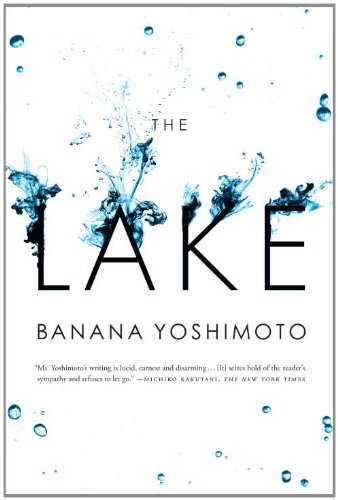
I wrote:
It's been some time since I finished a whole book in one day (and just two sittings).
One of the big mysteries of the book is revealed on the back cover (like the first sentence) so avoid reading the description. Seriously you're not supposed to know til almost the very end.
I can see why they did it - it's not quite the most central aspect of the book, though I'd argue it is somewhat important and would've been fascinating to have the reveal unspoiled.
Still, a very sweet, powerful story about being on the cusp of growing up and loving someone in spite of their (sometimes very heavy) baggage. Yoshimoto has a great, uncomplicated, direct style that is anything but "simple."
I still feel generally positive about this book, though I get the sense, after reading around a bit, that this is BY's sort of go-to plot template - people in transition and/or tragedy, so maybe I'd feel differently if I had a better understanding of the rest of her work. Still, it really is a very pleasant read, and I should be having an official review for it on the Three Percent blog in the next few weeks (I submitted it, but I got to wait my turn in the queue.)
An Empty Room: Stories, Mu Xin
Translated by Toming Jun Liu
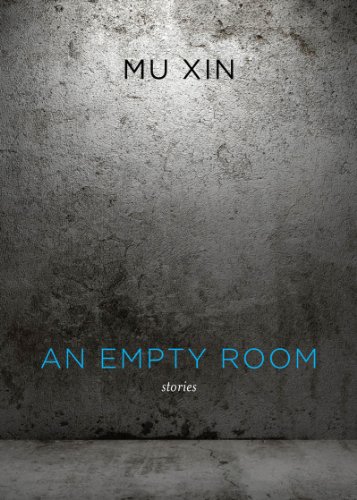
I wrote:
Wish there were half stars - I'd be tempted to give it 4.5 out of 5. Some really mesmerizing stuff here! Beautiful - particularly at it's best when dealing with melancholy memories etc. It's a collection of stories that don't always feel like stories - some are hard to think of as anything but a straight up retelling of a personal anecdote, and some that feel like an essay that doesn't really have a structure - a topic that meanders and digresses in a more or less agreeable way. I guess this comes from the Chinese literary form sanwen, which is deliberately a mix of fiction, memory, essay, prose, and poetry, according to the translator's afterword. Similar to the Japanese "I"-novel, perhaps, but in a much more abridged form.
In general skillfully translated, though the tone occasionally verges on the pompous (which might not be the fault of the translator, really). The one exception is "Quiet Afternoon Tea", which does not read well at all and is especially awkward in the characters' speech - all of which is (kind of) ironic, since it's one of the only story that ostensibly takes place in England with only British characters speaking in English. Maybe it was translated separately, first, a long time ago with little editing?
More to say in the future in a proper book review on Three Percent.
Like I wrote, another official review coming soon. These stories really are excellent, but I have some (read: a lot of complicated) things to say about the translation that is going to warrant it's own post when the review comes up.
The Jokers, Albert Cossery
Translated by Anna Moschovakis

I wrote:
Amusing, breezy, almost absurdist tale. Charming and humorous, political in its anti-political way, it felt like a sort of mix between Martin Amis "How I Became Stupid" and Ilf and Petrov's "The Golden Calf". Particularly great ending.
This book was written in the Sixties by a French born, Egypt living writer, but it is still surprisingly resonant in today's American political climate - especially when thinking about the Bush era. Thought-provoking but not dense, and not a shrill screed - a perfect (and fun) combo.
It is a little thin, admittedly; I think that is it's one flaw. But it's about guys pranking a public figure. It's pretty great.
I Have the Right to Destroy Myself, Young-ha Kim
Translated by Chi-Young Kim

I wrote:
Maybe 2.5 stars. I realized that the only part of the story I really didn't like was part 2 - I found C and K and Judith to be such annoying characters. The narrator was fascinating- I wish the story was more about him. C at least got a little more interesting when we find about his art, but K never gets developed. I just didn't care about their love triangle at all. It's not that I don't like dark books, but books like this or Hotel Iris don't move me when the characters are so underdeveloped- I don't feel their pain, and their depressions and nihilistic attitudes just seem weak and like "Oh woe is me" narcissism. Just seems like a cheap way to pile on tragedy. Not willing to write off Kim yet though- his other book seems interesting and I might yet check it out.
A lot of this book felt like a bad version of Murakami. Like taking some of Murakami's distinctive elements, ramping them up, and then messing up all the proportions into something inferior. The aloof protagonists become cooler-than-thou pricks, the Western culture name-dropping becomes snobby, the sex becomes dirty and overly gritty... I don't know, this just wasn't for me.
The Universal Baseball Association, Inc., J. Henry Waugh, Prop., Robert Coover

I wrote:
Some interesting stuff here, but your enjoyment does depend how much you enjoy reading about baseball games. Henry's an interesting character, and the last chapter adds a surprising layer to the rest of the work. But although I liked in general I was not inspired to pick it up and read it, so it took me a while to finish it.
Honestly, I read this because I read somewhere that Genichiro Takahashi's 優雅で感傷的な日本野球 was similar to this book. From what I read, it's not, really, except that it is kind of post-modern and has to do with baseball. It's about a guy who develops this table-top dice baseball game, that gets more and more complicated and takes over more and more of this guy Henry's life. It's very interesting, but if you don't at least enjoy baseball on some level, it'll be hard to read, since it gets very detailed in the goings on of each game.
Oblivion: Stories, David Foster Wallace

Goodreads score: 5 out of 5 stars
I wrote:
I think I loved every story but one, although that one story I was rather lukewarm to. But there's so much craft and intelligence and wit and raw emotion...Reading Wallace can occasionally be taxing, but worth it. He was truly a genius, in my opinion. Running out of short stories though...going to have to plunge into the almost bottomless pit that is that behemoth Infinite Jest soon.
Seriously you guys, David Foster Wallace is a genius. You have to give him a try if you haven't yet—at the very least a short story collection (even those can get long, but certainly less of a commitment than Infinite Jest). After Murakami, DFW is probably my favorite author.
Saturday, June 11, 2011
The 2011 Kenzaburo Oe Prize - 俺俺
Anyone with a passing interest in Japanese literature probably knows who Kenzaburo Oe is, if only by virtue of being one of only two Japanese to win the Nobel Prize for Literature back in 1994. That doesn't mean you've read him of course; for instance, I only got around to reading him about two years ago. If you haven't, A Personal Matter is quite good, as is The Changeling. The Silent Cry is another book that is cited among his best, though I haven't read that one yet.
Oe is an intensely personal, intensely intellectual, intensely political writer. He's a big issues kind of writer, even when the plot points seem to echo exactly events in his own life. So it's not surprising that the Academy was drawn to Oe as a candidate for the Nobel Prize, since, coincidentally or not, many of the winners are deeply political writers or individuals. So it's also not surprising that in Japan, he has a literary award in his honor. I mean, how much more internationally renowned can you get as a non-English writing author than winning the Nobel Prize?
I found out about the Kenzaburo Oe Award when I was exploring Gunzo a few months ago, since they made the announcement for the 2011 winner in their May issue. (Gunzo reporting it because both Gunzo and the award are run/sponsored by Kodansha.) It was established in honor of both the 100th anniversary of Kodansha being a company and the 50th "writing anniversary" of Kenzaburo Oe (which by the way, how much more perfect could that timing have been??).
Oe alone chooses the winner—the best novel of the past year.
The Kenzaburo Oe Prize winner is supposed to represent the best of the young generation's "literary intellectuals." It has no cash prize, but the work is to be translated into foreign languages for international publication. In the five years this prize has been acted, I don't think a single work has hit American or British bookshelves. Which I suppose isn't too surprising. I don't know the details about who gets to translates it or when or how, but even if it does get translated, I'm sure very few American publishers want to publish heady, "intellectual" novels from Japan. Just manga, sci-fi/fantasy/light novels, Murakami, and crime fiction please!
Partially inspired by Hopeful in Nagoya's recent diving into of Japanese book reviewing, I decided to try and learn more about this latest winner of the Kenzaburo Oe Prize.

The work is called 俺俺 by 星野智幸, or, Ore Ore by Tomoyuki Hoshino. This title would be hard to translate - it's a repetition of the word "I" or "me," used by dominant, confident, or familiar males, but the title refers to おれおれ詐欺, which is the term for a kind of phone scam. Basically, the perp calls an elderly person and pretends that they are their son or grandson, in order to get them to transfer them money from their bank accounts—basically, they say "Hey, it's me!" and trick their victims into thinking they're family.
Which is the basic premise of this story—a guy, only referred to as 俺, or I, goes to a McDonald's, steals his neighbor's cell phone, and commits a phone scam on this strangers' parents. But it gets stranger. According to the summary on Amazon Japan:
When I took the cell phone of the guy sitting next to me at McDonalds, I ended up committing a phone scam. But then I noticed that I was becoming a different I. The I for my bosses and parents, the I who isn't I, the I who is not I, the we that is I-I [literally: the 俺たち俺俺] So many I's that I don't know what is what anymore. Power off, off. Destroy. Before long, my fellow I's, going this way and that, increasing without end, until… A work that makes the reader ask: What is it, to trust another man, in this age of loneliness and despair?
Weird huh? But vague. So I took a look at the book review from the Asahi newspaper. It begins by repeating the basics of the Amazon summary: "I" goes to a McDonald's, on a whim steals a stranger's cell phone, and tricks the stranger's mother into thinking he was her son, and commits bank transfer fraud. Before he knows it, he starts to became that guy. And gradually, he begins to multiply into other "I"s.
The narrator "I" works at a large electronics store called "Megaton." (Kind of like a Best Buy I assume, perhaps in Akihabara). He seems to feel alienated by his job—even if he took over someone else's duties within the store, his day-to-day affairs wouldn't change. He believes his very existence is "weak", and easily replaceable by someone else. His boss is a mean person "incapable of being understood". The pressure to conform, to not stick out for fear of being made fun of, is overwhelming, and he and his fellow coworkers can barely get by working there. His sense of fitting in at work gets worse and worse, until he organizes a community (perhaps a literal place, like a commune) of "I"s, calling themselves (or the place) "I-Mountain" (俺山):
"At "I Mountain", everyone is I… "I Mountain" is a society without conflict with others. All the hearts of the "I"s are connected" - a transparent community where everyone can be understood. In a place like that, I, as a meaningful existence, is coming to an end. I am becoming no more than a part of a larger self, and the I's always living for each other. That experience is what sustains me."
Suffice it to say that as "I Mountain" starts to get larger, some major problems ensue.
The reviewer starts his/her review simply by calling it a "masterpiece" (傑作). The reviewer says the end took them completely be surprise, and even brought them to tears. The reviewer calls it a "monumental work" of contemporary literature, addressing the problems of identity in modern society.
Although the review seems almost a bit hyperbolic, 「俺俺」 sounds complicated, but awesome. In a strange way, it sort of reminds me of Fight Club, probably due to the weird nameless commune aspects, but it sounds like a fascinating work, one whose message would resonate beyond just Japan but throughout the world. When I have some extra cash I might try to pick it up sometime (it can be ordered from the Kinokuniya website if you live in the US). It's also probably worth checking out the other winners of the Kenzaburo Oe Prize, which you can find a list of, in English, on the Prize's Wikipedia page.
Oe is an intensely personal, intensely intellectual, intensely political writer. He's a big issues kind of writer, even when the plot points seem to echo exactly events in his own life. So it's not surprising that the Academy was drawn to Oe as a candidate for the Nobel Prize, since, coincidentally or not, many of the winners are deeply political writers or individuals. So it's also not surprising that in Japan, he has a literary award in his honor. I mean, how much more internationally renowned can you get as a non-English writing author than winning the Nobel Prize?
I found out about the Kenzaburo Oe Award when I was exploring Gunzo a few months ago, since they made the announcement for the 2011 winner in their May issue. (Gunzo reporting it because both Gunzo and the award are run/sponsored by Kodansha.) It was established in honor of both the 100th anniversary of Kodansha being a company and the 50th "writing anniversary" of Kenzaburo Oe (which by the way, how much more perfect could that timing have been??).
Oe alone chooses the winner—the best novel of the past year.
The Kenzaburo Oe Prize winner is supposed to represent the best of the young generation's "literary intellectuals." It has no cash prize, but the work is to be translated into foreign languages for international publication. In the five years this prize has been acted, I don't think a single work has hit American or British bookshelves. Which I suppose isn't too surprising. I don't know the details about who gets to translates it or when or how, but even if it does get translated, I'm sure very few American publishers want to publish heady, "intellectual" novels from Japan. Just manga, sci-fi/fantasy/light novels, Murakami, and crime fiction please!
Partially inspired by Hopeful in Nagoya's recent diving into of Japanese book reviewing, I decided to try and learn more about this latest winner of the Kenzaburo Oe Prize.
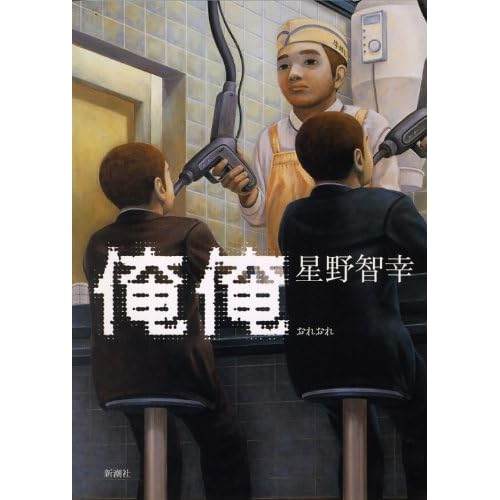
The work is called 俺俺 by 星野智幸, or, Ore Ore by Tomoyuki Hoshino. This title would be hard to translate - it's a repetition of the word "I" or "me," used by dominant, confident, or familiar males, but the title refers to おれおれ詐欺, which is the term for a kind of phone scam. Basically, the perp calls an elderly person and pretends that they are their son or grandson, in order to get them to transfer them money from their bank accounts—basically, they say "Hey, it's me!" and trick their victims into thinking they're family.
Which is the basic premise of this story—a guy, only referred to as 俺, or I, goes to a McDonald's, steals his neighbor's cell phone, and commits a phone scam on this strangers' parents. But it gets stranger. According to the summary on Amazon Japan:
When I took the cell phone of the guy sitting next to me at McDonalds, I ended up committing a phone scam. But then I noticed that I was becoming a different I. The I for my bosses and parents, the I who isn't I, the I who is not I, the we that is I-I [literally: the 俺たち俺俺] So many I's that I don't know what is what anymore. Power off, off. Destroy. Before long, my fellow I's, going this way and that, increasing without end, until… A work that makes the reader ask: What is it, to trust another man, in this age of loneliness and despair?
Weird huh? But vague. So I took a look at the book review from the Asahi newspaper. It begins by repeating the basics of the Amazon summary: "I" goes to a McDonald's, on a whim steals a stranger's cell phone, and tricks the stranger's mother into thinking he was her son, and commits bank transfer fraud. Before he knows it, he starts to became that guy. And gradually, he begins to multiply into other "I"s.
The narrator "I" works at a large electronics store called "Megaton." (Kind of like a Best Buy I assume, perhaps in Akihabara). He seems to feel alienated by his job—even if he took over someone else's duties within the store, his day-to-day affairs wouldn't change. He believes his very existence is "weak", and easily replaceable by someone else. His boss is a mean person "incapable of being understood". The pressure to conform, to not stick out for fear of being made fun of, is overwhelming, and he and his fellow coworkers can barely get by working there. His sense of fitting in at work gets worse and worse, until he organizes a community (perhaps a literal place, like a commune) of "I"s, calling themselves (or the place) "I-Mountain" (俺山):
"At "I Mountain", everyone is I… "I Mountain" is a society without conflict with others. All the hearts of the "I"s are connected" - a transparent community where everyone can be understood. In a place like that, I, as a meaningful existence, is coming to an end. I am becoming no more than a part of a larger self, and the I's always living for each other. That experience is what sustains me."
Suffice it to say that as "I Mountain" starts to get larger, some major problems ensue.
The reviewer starts his/her review simply by calling it a "masterpiece" (傑作). The reviewer says the end took them completely be surprise, and even brought them to tears. The reviewer calls it a "monumental work" of contemporary literature, addressing the problems of identity in modern society.
Although the review seems almost a bit hyperbolic, 「俺俺」 sounds complicated, but awesome. In a strange way, it sort of reminds me of Fight Club, probably due to the weird nameless commune aspects, but it sounds like a fascinating work, one whose message would resonate beyond just Japan but throughout the world. When I have some extra cash I might try to pick it up sometime (it can be ordered from the Kinokuniya website if you live in the US). It's also probably worth checking out the other winners of the Kenzaburo Oe Prize, which you can find a list of, in English, on the Prize's Wikipedia page.
Monday, April 25, 2011
Monkey Business: A New Japan-based Literary Journal
Good news, everyone!
Actually, better than that: pretty awesome news.
The literary journal A Public Space is producing an American version of the Japanese literary journal Monkey Business which will highlight contemporary Japanese literature in English translation!
Holy shit! That's great!
[This is all via Three Percent, by the way.]
It's being edited and put together by Motoyuki Shibata, an English translator of contemporary authors like Thomas Pynchon and Paul Auster, and founder of the original Japanese journal Monkey Business, Ted Goosen, a Japanese translator, and Roland Kelts, author of Japanamerica.
And the selection looks amazing. Some highlights include:
Monsters, a short story by Hideo Furukawa (remember how we were talking about Belka, Why Don't You Bark last week?)
translated by Michael Emmerich
People from My Neighborhood: a collection of vignettes by Hiromi Kawakami (author of the recent Manazuru, which I should have a review of up on Three Percent in the next couple weeks)
translated by Ted Goossen
The Tale of the House of Physics: a short story by Yoko Ogawa (author of The Housekeeper and the Professor and Hotel Iris)
translated by Ted Goossen
Pursuing “Growth”: an interview with Haruki Murakami by Hideo Furukawa (Oh how I want to read this...)
translated by Ted Goossen
And tons more, including a lot of poetry, and a manga version of Kafka. You can see the whole table of contents at the A Public Space website.
Not only that, as far as I can tell, this isn't a one time thing. This is just the first issue—although it will only be coming out once a year.
Still, though, I'm extremely pumped. An entire literary journal devoted to Japanese literature? That will come out regularly? Yes and yes. You can order it here, like I already have.
Actually, better than that: pretty awesome news.
The literary journal A Public Space is producing an American version of the Japanese literary journal Monkey Business which will highlight contemporary Japanese literature in English translation!
Holy shit! That's great!
[This is all via Three Percent, by the way.]
It's being edited and put together by Motoyuki Shibata, an English translator of contemporary authors like Thomas Pynchon and Paul Auster, and founder of the original Japanese journal Monkey Business, Ted Goosen, a Japanese translator, and Roland Kelts, author of Japanamerica.
And the selection looks amazing. Some highlights include:
Monsters, a short story by Hideo Furukawa (remember how we were talking about Belka, Why Don't You Bark last week?)
translated by Michael Emmerich
People from My Neighborhood: a collection of vignettes by Hiromi Kawakami (author of the recent Manazuru, which I should have a review of up on Three Percent in the next couple weeks)
translated by Ted Goossen
The Tale of the House of Physics: a short story by Yoko Ogawa (author of The Housekeeper and the Professor and Hotel Iris)
translated by Ted Goossen
Pursuing “Growth”: an interview with Haruki Murakami by Hideo Furukawa (Oh how I want to read this...)
translated by Ted Goossen
And tons more, including a lot of poetry, and a manga version of Kafka. You can see the whole table of contents at the A Public Space website.
Not only that, as far as I can tell, this isn't a one time thing. This is just the first issue—although it will only be coming out once a year.
Still, though, I'm extremely pumped. An entire literary journal devoted to Japanese literature? That will come out regularly? Yes and yes. You can order it here, like I already have.
Saturday, April 23, 2011
Possibly Forthcoming JLPP Books, Part 4
The list continues! [Explanation on the JLPP and this journey here.]
Although I'll admit I didn't fully plan it this way, last week I focused on the top three books that I was most excited about seeing possibly published into English. I took a little break, and afterward I realized that although there were some books that I was curious about reading, for whatever reason, they didn't have me as excited as those three.
So it's fitting that I'm starting another round after taking a break to talk about the Fukko Shoten, because I can think of this as the 2nd round of the draft. They also have the potential to be interesting, but my excitement is a bit more tempered than my 1st round draft. (Please forgive me of my tenuous use of a sports metaphor. Talking about sports is not my strong suit, surprising as that may be coming from someone who writes a literature in translation blog.) As such, in addition to the Why I'm Excited column I'm going to add a Why I'm Hesitant column too this round.
(Also, this will probably be my last round of books. Since this series of posts is called "Possibly Forthcoming JLPP Books I'm Excited About," I'm not going to bother listing all the other books that look like they are boring, crappy, or otherwise not my thing, which there are quite a few.)
Anyway, off we go!
The Downfall of Matias Guili
Natsuki Ikezawa
Translated by Alfred Birnbaum

Why I'm Excited: First of all, like Michael Emmerich re: Belka, Why Don't You Bark?, I trust Alfred Birnbaum as a translator: he brought Haruki Murakami to English speakers. How can I not swear allegiance? Because translators don't always get to work on projects they like? (Shh, let's not complicate matters.)
Actually, despite that parenthetical aside, he hasn't done that many translations: as far as I can tell, besides Murakami he worked on some of the translations in Monkey Brain Sushi, Miyuki Miyabe's All She Was Worth and Natsuki Ikezawa (a.k.a. the guy we're talking about right now, you guys!)'s A Burden of Flowers. So it could very well be a passion project.
Speaking of Ikezawa himself, he has a surprising (it's sad, really, but it's true) two novels already in English translation: the aforementioned A Burden of Flowers and Still Lives, which was translated by Dennis Keene. The reviews on Goodreads are good, especially for Still Lives (4 stars), though I haven't read either.
The Downfall of Matias Guili itself is described by the JLPP as a "magical realist epic" in the vein of Garcia Marquez set in a fictional island in the South Pacific that is constantly being taken over by foreign countries, until it finally achieves independence. The new President Matias Guili is a "Japanophile" who, through some mysterious turns of events, becomes suspicious of a guerrilla uprising against him. It's won the Tanizaki prize and considered Ikezawa's "crowning achievement" of his first decade of fiction writing.
Why I'm Hesitant: Frankly, I hate Garcia Marquez. I remember vaguely liking his short story "Handsomest Drowned Man in the World" in high school, but I barely made it through Love in the Time of Cholera and could only get through thirty pages of Chronicle of a Death Foretold before I just put it down. So for me, that's a terrible association to make. Of course, everyone else in the world loves Marquez, so maybe I'm just wrong on this one.
Words Without Borders has an excerpt of The Downfall of Matias Guili in their June 2005 issue (somewhat hilariously, it's called "The A Team"). I read it, and found it kind of boring. The style was amusing, as was its portrayal of bureaucracy (needlessly complicated) and international relations (toothless), but I just didn't have particularly strong feelings about it. The excerpt is called "a lost chapter" of the book, so I don't know how it fits into the novel at all, or even if it will be in the final product. But it didn't get me hooked.
It's supposed to be a very political novel. Like with Marquez, that's not an inherently bad thing, but for me, I hope it brings something more to the table in the way of characters or style than just being some sort of manifesto-as-fiction on international diplomacy or the treatment of third world countries, which is the sense that I get from the descriptions about it. But again, that's just my personal taste talking here.
One more matter is troubling. The Downfall of Matias Guili is also from the JLPP's 2nd draft of picks. The excerpt from World Without Borders is from 2005, and the fine print says that the novel was going to come out in 2006. What happened? Did this book have a publisher who ended up backing out? Why hasn't anyone been willing to publish it since? My fear is that the book is actually terrible, and that's why no one wants it.
My feelings for this book are definitely more complicated than the others I've talked about so far, but I would still definitely try reading it if it does (eventually) come out.
Although I'll admit I didn't fully plan it this way, last week I focused on the top three books that I was most excited about seeing possibly published into English. I took a little break, and afterward I realized that although there were some books that I was curious about reading, for whatever reason, they didn't have me as excited as those three.
So it's fitting that I'm starting another round after taking a break to talk about the Fukko Shoten, because I can think of this as the 2nd round of the draft. They also have the potential to be interesting, but my excitement is a bit more tempered than my 1st round draft. (Please forgive me of my tenuous use of a sports metaphor. Talking about sports is not my strong suit, surprising as that may be coming from someone who writes a literature in translation blog.) As such, in addition to the Why I'm Excited column I'm going to add a Why I'm Hesitant column too this round.
(Also, this will probably be my last round of books. Since this series of posts is called "Possibly Forthcoming JLPP Books I'm Excited About," I'm not going to bother listing all the other books that look like they are boring, crappy, or otherwise not my thing, which there are quite a few.)
Anyway, off we go!
The Downfall of Matias Guili
Natsuki Ikezawa
Translated by Alfred Birnbaum

Why I'm Excited: First of all, like Michael Emmerich re: Belka, Why Don't You Bark?, I trust Alfred Birnbaum as a translator: he brought Haruki Murakami to English speakers. How can I not swear allegiance? Because translators don't always get to work on projects they like? (Shh, let's not complicate matters.)
Actually, despite that parenthetical aside, he hasn't done that many translations: as far as I can tell, besides Murakami he worked on some of the translations in Monkey Brain Sushi, Miyuki Miyabe's All She Was Worth and Natsuki Ikezawa (a.k.a. the guy we're talking about right now, you guys!)'s A Burden of Flowers. So it could very well be a passion project.
Speaking of Ikezawa himself, he has a surprising (it's sad, really, but it's true) two novels already in English translation: the aforementioned A Burden of Flowers and Still Lives, which was translated by Dennis Keene. The reviews on Goodreads are good, especially for Still Lives (4 stars), though I haven't read either.
The Downfall of Matias Guili itself is described by the JLPP as a "magical realist epic" in the vein of Garcia Marquez set in a fictional island in the South Pacific that is constantly being taken over by foreign countries, until it finally achieves independence. The new President Matias Guili is a "Japanophile" who, through some mysterious turns of events, becomes suspicious of a guerrilla uprising against him. It's won the Tanizaki prize and considered Ikezawa's "crowning achievement" of his first decade of fiction writing.
Why I'm Hesitant: Frankly, I hate Garcia Marquez. I remember vaguely liking his short story "Handsomest Drowned Man in the World" in high school, but I barely made it through Love in the Time of Cholera and could only get through thirty pages of Chronicle of a Death Foretold before I just put it down. So for me, that's a terrible association to make. Of course, everyone else in the world loves Marquez, so maybe I'm just wrong on this one.
Words Without Borders has an excerpt of The Downfall of Matias Guili in their June 2005 issue (somewhat hilariously, it's called "The A Team"). I read it, and found it kind of boring. The style was amusing, as was its portrayal of bureaucracy (needlessly complicated) and international relations (toothless), but I just didn't have particularly strong feelings about it. The excerpt is called "a lost chapter" of the book, so I don't know how it fits into the novel at all, or even if it will be in the final product. But it didn't get me hooked.
It's supposed to be a very political novel. Like with Marquez, that's not an inherently bad thing, but for me, I hope it brings something more to the table in the way of characters or style than just being some sort of manifesto-as-fiction on international diplomacy or the treatment of third world countries, which is the sense that I get from the descriptions about it. But again, that's just my personal taste talking here.
One more matter is troubling. The Downfall of Matias Guili is also from the JLPP's 2nd draft of picks. The excerpt from World Without Borders is from 2005, and the fine print says that the novel was going to come out in 2006. What happened? Did this book have a publisher who ended up backing out? Why hasn't anyone been willing to publish it since? My fear is that the book is actually terrible, and that's why no one wants it.
My feelings for this book are definitely more complicated than the others I've talked about so far, but I would still definitely try reading it if it does (eventually) come out.
Friday, April 15, 2011
Possibly Forthcoming JLPP Books, Part 3
Hello friends. In case you're new here, this week I'm taking a look at books selected by the JLPP for translation that I think will be a fun read, whenever it happens to come out. [Please see Part 1 in this series to see how the JLPP works, etc.]
I don't really have any other comments to make before getting to the meat of the piece like I did last time, so let's just get right to it!
So today we have...
Belka, Why Don't You Bark?
Hideo Furukawa
Translated by Michael Emmerich

Why I'm Excited: This one's a bit easier to explain, because before I read about this book, I hadn't even heard of the author, much less this particular title.
I know, I know - I'm not inspiring much confidence so far. But I think the presence of Michael Emmerich as translator is excitement enough.
I've been lucky enough to talk with Emmerich twice now, most recently a few weeks ago. One of the things he said was that as a translator he's been very lucky, since with very few exceptions, he's been able to select the projects he works on, and he said that all the works he's worked on, even if it wasn't his idea initially to translate a particular piece, he's found that every work he's translated has had something interesting about it.
And if you look at what he's translated, you'll see he's got a great track record and a man of pretty great taste: Yasunari Kawabata, Banana Yoshimoto, Rieko Matsuura, Hiromi Kawakami (his translation of Manazuru won the "Japan-U.S. Friendship Commission Prize for the Translation of Japanese Literature"; though my feelings to that book are mixed), and, of course, my current literary obsession, Genichiro Takahashi. So I can't say I've loved everything he's done (another example: I respect Matsuura's The Apprenticeship of Big Toe P, but I wouldn't want to read it again any time soon), but he's an incredibly intelligent guy and a great translator.
But Belka, Why Don't You Bark truly does, in its own right, look interesting. According to the J-Lit organization, Hideo Furukawa is "a literary powerhouse" and described by many literary critics as "ushering in a new 'post Haruki Murakami' era in Japanese fiction." Obviously the J-Lit Organization is going to try and make their authors sound good, but I think it's very interesting that they'd describe him as "post-Murakami," which to me implies a replacement of Murakami, as if we don't need him anymore because we've found someone better. A bit of hyperbole, probably, but, damn if I'm not intrigued.
In fact, according to his Wikipedia page, he's a Murakami super-fan - including writing a "tribute" of Murakami's short story "A Slow Boat to China," first called "A Slow Boat to China RMX" and then retitled "Slow Boat 2002." I don't know what the contents of the story are so I don't know what a "tribute" means, but I sure wish I could read it for myself. Maybe it's Furukawa's list of the first Chinese people HE met.
Also, Furukawa sounds like a cool dude (like Ko Machida) because since 2006 he's been jamming with Mukai Shutoku, leader of the seminal indie rock bands Number Girl and Zazen Boys (whose experimental math rock style I like a little better than the more straightforward 90s alt-rock of Number Girl).
Belka, Why Don't You Bark? is kind of a history novel starting from WWII, then the Korean War, and the Space Race, but by following a pair of dogs and their many offspring and their roles in these major world events. At the same time, though, it also has another narrative about a KGB dog breeder who kidnaps a yakuza's daughter, and these two narrative threads eventually merge.
I'll admit the first plot line sounds more interesting than the second one, but I still think it's a really neat idea. I also like the way the JLPP describes it as a cross between "pure literature" and "entertainment literature" - which is basically how the literary circles describe Haruki Murakami. Not too dry or pretentiousness and not pure fluff either. And again, if it caught Michael Emmerich's attention, I'll definitely give it a shot.
I don't really have any other comments to make before getting to the meat of the piece like I did last time, so let's just get right to it!
So today we have...
Belka, Why Don't You Bark?
Hideo Furukawa
Translated by Michael Emmerich

Why I'm Excited: This one's a bit easier to explain, because before I read about this book, I hadn't even heard of the author, much less this particular title.
I know, I know - I'm not inspiring much confidence so far. But I think the presence of Michael Emmerich as translator is excitement enough.
I've been lucky enough to talk with Emmerich twice now, most recently a few weeks ago. One of the things he said was that as a translator he's been very lucky, since with very few exceptions, he's been able to select the projects he works on, and he said that all the works he's worked on, even if it wasn't his idea initially to translate a particular piece, he's found that every work he's translated has had something interesting about it.
And if you look at what he's translated, you'll see he's got a great track record and a man of pretty great taste: Yasunari Kawabata, Banana Yoshimoto, Rieko Matsuura, Hiromi Kawakami (his translation of Manazuru won the "Japan-U.S. Friendship Commission Prize for the Translation of Japanese Literature"; though my feelings to that book are mixed), and, of course, my current literary obsession, Genichiro Takahashi. So I can't say I've loved everything he's done (another example: I respect Matsuura's The Apprenticeship of Big Toe P, but I wouldn't want to read it again any time soon), but he's an incredibly intelligent guy and a great translator.
But Belka, Why Don't You Bark truly does, in its own right, look interesting. According to the J-Lit organization, Hideo Furukawa is "a literary powerhouse" and described by many literary critics as "ushering in a new 'post Haruki Murakami' era in Japanese fiction." Obviously the J-Lit Organization is going to try and make their authors sound good, but I think it's very interesting that they'd describe him as "post-Murakami," which to me implies a replacement of Murakami, as if we don't need him anymore because we've found someone better. A bit of hyperbole, probably, but, damn if I'm not intrigued.
In fact, according to his Wikipedia page, he's a Murakami super-fan - including writing a "tribute" of Murakami's short story "A Slow Boat to China," first called "A Slow Boat to China RMX" and then retitled "Slow Boat 2002." I don't know what the contents of the story are so I don't know what a "tribute" means, but I sure wish I could read it for myself. Maybe it's Furukawa's list of the first Chinese people HE met.
Also, Furukawa sounds like a cool dude (like Ko Machida) because since 2006 he's been jamming with Mukai Shutoku, leader of the seminal indie rock bands Number Girl and Zazen Boys (whose experimental math rock style I like a little better than the more straightforward 90s alt-rock of Number Girl).
Belka, Why Don't You Bark? is kind of a history novel starting from WWII, then the Korean War, and the Space Race, but by following a pair of dogs and their many offspring and their roles in these major world events. At the same time, though, it also has another narrative about a KGB dog breeder who kidnaps a yakuza's daughter, and these two narrative threads eventually merge.
I'll admit the first plot line sounds more interesting than the second one, but I still think it's a really neat idea. I also like the way the JLPP describes it as a cross between "pure literature" and "entertainment literature" - which is basically how the literary circles describe Haruki Murakami. Not too dry or pretentiousness and not pure fluff either. And again, if it caught Michael Emmerich's attention, I'll definitely give it a shot.
Wednesday, April 13, 2011
Possibly Forthcoming JLPP Books, Part 2
Over the next few days I'm going to highlight some of the newest books selected by the JLPP that may be published soon(*) and that I'm particularly excited to read. (See my recent post to catch up on the whole spiel, as well as the reasons why I'm excited about Masahiko Shimada's Death Penalty.)
(*)As I was doing my research, I saw something that made me profoundly disappointed. Most of the books on the list they have for publishers have been around a long time now. Masahiko Shimada's Death Penalty wasn't even part of the 5th round of drafts, it was in the 4th. The book I'm going to talk about below (along with many others) was discussed in this post from the Three Percent blog last May. The Downfall of Matias Guili by Natsuki Ikezawa, another book I think sounds fascinating and want to talk about soon, was from the 2nd round(!) of selected books.
Why aren't publishers picking up these books?? It's really too bad. I certainly wouldn't defend the literary merit of every book on the JLPP list (since some of them seem like rather questionable choices to me, not to name names...), but some of them are moderately to really good contemporary work (The Apprenticeship of Big Toe P and Manazuru) while others are undisputed classics or from important authors (Botchan, The Glass Slipper and Other Stories, etc.).
I guess I just wonder if (and which) publishers have read which works, and why they disliked them or found them to be so severely unprofitable. I know it takes time to publish books, but some of these books have been on the market forever - not only that, but fully translated and ready to go.
[So I guess I'm just going to pretend me talking about them will drum up interest somehow and publishers will suddenly decide to publish the books.]
[Also, on the up side, if they announced round 5 so long ago, maybe round 6 will be coming up soon and we get a whole new round of books to look forward to...]
Sigh. Anyway...
Punk Samurai and the Cult
Ko Machida
Translated by Wayne P. Lammers

Why I'm Excited: Ko Machida is like Haruki Murakami in a way - his initial aims in life had nothing to do with literature. He was first famous in the critically acclaimed punk band INU, and then many other acts, in the 80s, and then dabbled in acting, including a starring role in the sci-fi/punk rock musical movie Burst City. (I've never seen the movie but this trailer looks insane in an awesome way:)
In the early 90s he started writing poetry, and then fiction, and he's won a bunch of the big awards, including the Akutagawa and the Tanizaki.
The JLPP describes Punk Samurai and the Cult as a "fabulously preposterous historical novel." The plot revolves around one samurai witnessing another samurai suddenly murdering a seemingly harmless old man and his daughter, but it turns out the old man was a member of the secret religious cult "The Belly Shaking Party" and the samurai did not want the religion to spread. The samurai witness goes to talk to his boss, and his boss then joins up with the killer samurai (in a classic buddy-cop opposite people style: the first samurai is an academic but terrible at swordplay, the second samurai a master swordsman but dumb as a rock) to take down this cult.
The genre tag for Punk Samurai and the Cult given by the JLPP is "Fantasy/Surreal/Horror," but it also sounds like it'll have a killer sense of humor.
Machida has won some awards for fiction, but the fact that he doesn't come from a literary background could keep this novel from being well-crafted or elegantly structured, and being instead choppy or aimless, as I find a lot of Japanese literature to suffer from, at least from my Western-literature-educated eyes. Still, the offbeat sensibility is what appeals to me, and Machida has proven himself in the literary circles to be a talented writer, so I have high, though cautious, hopes.
(*)As I was doing my research, I saw something that made me profoundly disappointed. Most of the books on the list they have for publishers have been around a long time now. Masahiko Shimada's Death Penalty wasn't even part of the 5th round of drafts, it was in the 4th. The book I'm going to talk about below (along with many others) was discussed in this post from the Three Percent blog last May. The Downfall of Matias Guili by Natsuki Ikezawa, another book I think sounds fascinating and want to talk about soon, was from the 2nd round(!) of selected books.
Why aren't publishers picking up these books?? It's really too bad. I certainly wouldn't defend the literary merit of every book on the JLPP list (since some of them seem like rather questionable choices to me, not to name names...), but some of them are moderately to really good contemporary work (The Apprenticeship of Big Toe P and Manazuru) while others are undisputed classics or from important authors (Botchan, The Glass Slipper and Other Stories, etc.).
I guess I just wonder if (and which) publishers have read which works, and why they disliked them or found them to be so severely unprofitable. I know it takes time to publish books, but some of these books have been on the market forever - not only that, but fully translated and ready to go.
[So I guess I'm just going to pretend me talking about them will drum up interest somehow and publishers will suddenly decide to publish the books.]
[Also, on the up side, if they announced round 5 so long ago, maybe round 6 will be coming up soon and we get a whole new round of books to look forward to...]
Sigh. Anyway...
Punk Samurai and the Cult
Ko Machida
Translated by Wayne P. Lammers

Why I'm Excited: Ko Machida is like Haruki Murakami in a way - his initial aims in life had nothing to do with literature. He was first famous in the critically acclaimed punk band INU, and then many other acts, in the 80s, and then dabbled in acting, including a starring role in the sci-fi/punk rock musical movie Burst City. (I've never seen the movie but this trailer looks insane in an awesome way:)
In the early 90s he started writing poetry, and then fiction, and he's won a bunch of the big awards, including the Akutagawa and the Tanizaki.
The JLPP describes Punk Samurai and the Cult as a "fabulously preposterous historical novel." The plot revolves around one samurai witnessing another samurai suddenly murdering a seemingly harmless old man and his daughter, but it turns out the old man was a member of the secret religious cult "The Belly Shaking Party" and the samurai did not want the religion to spread. The samurai witness goes to talk to his boss, and his boss then joins up with the killer samurai (in a classic buddy-cop opposite people style: the first samurai is an academic but terrible at swordplay, the second samurai a master swordsman but dumb as a rock) to take down this cult.
The genre tag for Punk Samurai and the Cult given by the JLPP is "Fantasy/Surreal/Horror," but it also sounds like it'll have a killer sense of humor.
Machida has won some awards for fiction, but the fact that he doesn't come from a literary background could keep this novel from being well-crafted or elegantly structured, and being instead choppy or aimless, as I find a lot of Japanese literature to suffer from, at least from my Western-literature-educated eyes. Still, the offbeat sensibility is what appeals to me, and Machida has proven himself in the literary circles to be a talented writer, so I have high, though cautious, hopes.
Subscribe to:
Posts (Atom)