And we're back! Two and a half weeks go by fast, don't they? If only this blog could be my job! (Then I wouldn't be so broke or stressed out...)
Anyway, no time for stress! It's summer! Why don't we use the time not spent at the beach (or applying to jobs) with a little translating?
Yes, it's that time again: Kurodahan Press has announced it's 2011 Translation Prize and is now accepting submissions.
It's a 30,000 yen cash prize, publication in a forthcoming collection by Kurodahan Press, with additional compensation on publication. Deadline is September 30, 2011, and the results are announced at the end of the year. Mid-December, as I recall: I was right in the middle of writing one of my finals when I got the email.
We covered this contest last year here. Last year's piece was an interesting bit of flash fiction and saying anymore about it would sort of ruin the story's big surprise, but you can read all the entries at the Kurodahan Press website, if you scroll almost all the way to the bottom. The entries are anonymous, so you'll never know which one was my somewhat embarrassingly low-scoring submission...
This year's piece is 蝶の断片 by a certain 加門七海. I haven't read the piece yet, but I'm betting that it's a ghost story, since the author seems to be famous for/interested in them.
The Prize will be judged by three translators, though they've only announced two: Juliet Winters Carpenter, who judged last year and has translated Kobo Abe among others, and Nancy Ross, who won the 2008 Kurodahan Press Translation Prize, as well as the Distinguished Translation Award in the 4th Shizuoka International Translation Competition in 2003, an unfortunately now defunct prize.
You can download the PDF of the translation materials, as well as get all the contest details and rules, here.
Happy translating!
Showing posts with label prize. Show all posts
Showing posts with label prize. Show all posts
Monday, July 11, 2011


Saturday, June 11, 2011
The 2011 Kenzaburo Oe Prize - 俺俺
Anyone with a passing interest in Japanese literature probably knows who Kenzaburo Oe is, if only by virtue of being one of only two Japanese to win the Nobel Prize for Literature back in 1994. That doesn't mean you've read him of course; for instance, I only got around to reading him about two years ago. If you haven't, A Personal Matter is quite good, as is The Changeling. The Silent Cry is another book that is cited among his best, though I haven't read that one yet.
Oe is an intensely personal, intensely intellectual, intensely political writer. He's a big issues kind of writer, even when the plot points seem to echo exactly events in his own life. So it's not surprising that the Academy was drawn to Oe as a candidate for the Nobel Prize, since, coincidentally or not, many of the winners are deeply political writers or individuals. So it's also not surprising that in Japan, he has a literary award in his honor. I mean, how much more internationally renowned can you get as a non-English writing author than winning the Nobel Prize?
I found out about the Kenzaburo Oe Award when I was exploring Gunzo a few months ago, since they made the announcement for the 2011 winner in their May issue. (Gunzo reporting it because both Gunzo and the award are run/sponsored by Kodansha.) It was established in honor of both the 100th anniversary of Kodansha being a company and the 50th "writing anniversary" of Kenzaburo Oe (which by the way, how much more perfect could that timing have been??).
Oe alone chooses the winner—the best novel of the past year.
The Kenzaburo Oe Prize winner is supposed to represent the best of the young generation's "literary intellectuals." It has no cash prize, but the work is to be translated into foreign languages for international publication. In the five years this prize has been acted, I don't think a single work has hit American or British bookshelves. Which I suppose isn't too surprising. I don't know the details about who gets to translates it or when or how, but even if it does get translated, I'm sure very few American publishers want to publish heady, "intellectual" novels from Japan. Just manga, sci-fi/fantasy/light novels, Murakami, and crime fiction please!
Partially inspired by Hopeful in Nagoya's recent diving into of Japanese book reviewing, I decided to try and learn more about this latest winner of the Kenzaburo Oe Prize.
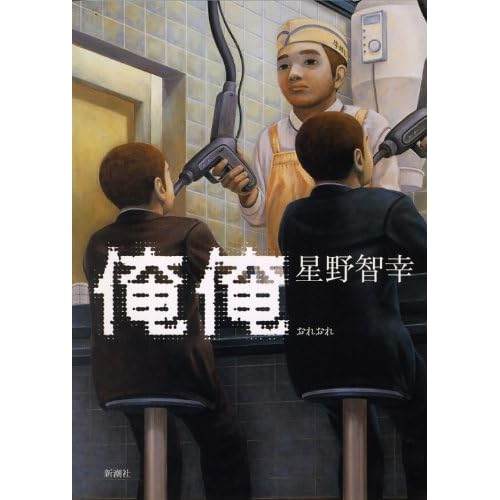
The work is called 俺俺 by 星野智幸, or, Ore Ore by Tomoyuki Hoshino. This title would be hard to translate - it's a repetition of the word "I" or "me," used by dominant, confident, or familiar males, but the title refers to おれおれ詐欺, which is the term for a kind of phone scam. Basically, the perp calls an elderly person and pretends that they are their son or grandson, in order to get them to transfer them money from their bank accounts—basically, they say "Hey, it's me!" and trick their victims into thinking they're family.
Which is the basic premise of this story—a guy, only referred to as 俺, or I, goes to a McDonald's, steals his neighbor's cell phone, and commits a phone scam on this strangers' parents. But it gets stranger. According to the summary on Amazon Japan:
When I took the cell phone of the guy sitting next to me at McDonalds, I ended up committing a phone scam. But then I noticed that I was becoming a different I. The I for my bosses and parents, the I who isn't I, the I who is not I, the we that is I-I [literally: the 俺たち俺俺] So many I's that I don't know what is what anymore. Power off, off. Destroy. Before long, my fellow I's, going this way and that, increasing without end, until… A work that makes the reader ask: What is it, to trust another man, in this age of loneliness and despair?
Weird huh? But vague. So I took a look at the book review from the Asahi newspaper. It begins by repeating the basics of the Amazon summary: "I" goes to a McDonald's, on a whim steals a stranger's cell phone, and tricks the stranger's mother into thinking he was her son, and commits bank transfer fraud. Before he knows it, he starts to became that guy. And gradually, he begins to multiply into other "I"s.
The narrator "I" works at a large electronics store called "Megaton." (Kind of like a Best Buy I assume, perhaps in Akihabara). He seems to feel alienated by his job—even if he took over someone else's duties within the store, his day-to-day affairs wouldn't change. He believes his very existence is "weak", and easily replaceable by someone else. His boss is a mean person "incapable of being understood". The pressure to conform, to not stick out for fear of being made fun of, is overwhelming, and he and his fellow coworkers can barely get by working there. His sense of fitting in at work gets worse and worse, until he organizes a community (perhaps a literal place, like a commune) of "I"s, calling themselves (or the place) "I-Mountain" (俺山):
"At "I Mountain", everyone is I… "I Mountain" is a society without conflict with others. All the hearts of the "I"s are connected" - a transparent community where everyone can be understood. In a place like that, I, as a meaningful existence, is coming to an end. I am becoming no more than a part of a larger self, and the I's always living for each other. That experience is what sustains me."
Suffice it to say that as "I Mountain" starts to get larger, some major problems ensue.
The reviewer starts his/her review simply by calling it a "masterpiece" (傑作). The reviewer says the end took them completely be surprise, and even brought them to tears. The reviewer calls it a "monumental work" of contemporary literature, addressing the problems of identity in modern society.
Although the review seems almost a bit hyperbolic, 「俺俺」 sounds complicated, but awesome. In a strange way, it sort of reminds me of Fight Club, probably due to the weird nameless commune aspects, but it sounds like a fascinating work, one whose message would resonate beyond just Japan but throughout the world. When I have some extra cash I might try to pick it up sometime (it can be ordered from the Kinokuniya website if you live in the US). It's also probably worth checking out the other winners of the Kenzaburo Oe Prize, which you can find a list of, in English, on the Prize's Wikipedia page.
Oe is an intensely personal, intensely intellectual, intensely political writer. He's a big issues kind of writer, even when the plot points seem to echo exactly events in his own life. So it's not surprising that the Academy was drawn to Oe as a candidate for the Nobel Prize, since, coincidentally or not, many of the winners are deeply political writers or individuals. So it's also not surprising that in Japan, he has a literary award in his honor. I mean, how much more internationally renowned can you get as a non-English writing author than winning the Nobel Prize?
I found out about the Kenzaburo Oe Award when I was exploring Gunzo a few months ago, since they made the announcement for the 2011 winner in their May issue. (Gunzo reporting it because both Gunzo and the award are run/sponsored by Kodansha.) It was established in honor of both the 100th anniversary of Kodansha being a company and the 50th "writing anniversary" of Kenzaburo Oe (which by the way, how much more perfect could that timing have been??).
Oe alone chooses the winner—the best novel of the past year.
The Kenzaburo Oe Prize winner is supposed to represent the best of the young generation's "literary intellectuals." It has no cash prize, but the work is to be translated into foreign languages for international publication. In the five years this prize has been acted, I don't think a single work has hit American or British bookshelves. Which I suppose isn't too surprising. I don't know the details about who gets to translates it or when or how, but even if it does get translated, I'm sure very few American publishers want to publish heady, "intellectual" novels from Japan. Just manga, sci-fi/fantasy/light novels, Murakami, and crime fiction please!
Partially inspired by Hopeful in Nagoya's recent diving into of Japanese book reviewing, I decided to try and learn more about this latest winner of the Kenzaburo Oe Prize.
The work is called 俺俺 by 星野智幸, or, Ore Ore by Tomoyuki Hoshino. This title would be hard to translate - it's a repetition of the word "I" or "me," used by dominant, confident, or familiar males, but the title refers to おれおれ詐欺, which is the term for a kind of phone scam. Basically, the perp calls an elderly person and pretends that they are their son or grandson, in order to get them to transfer them money from their bank accounts—basically, they say "Hey, it's me!" and trick their victims into thinking they're family.
Which is the basic premise of this story—a guy, only referred to as 俺, or I, goes to a McDonald's, steals his neighbor's cell phone, and commits a phone scam on this strangers' parents. But it gets stranger. According to the summary on Amazon Japan:
When I took the cell phone of the guy sitting next to me at McDonalds, I ended up committing a phone scam. But then I noticed that I was becoming a different I. The I for my bosses and parents, the I who isn't I, the I who is not I, the we that is I-I [literally: the 俺たち俺俺] So many I's that I don't know what is what anymore. Power off, off. Destroy. Before long, my fellow I's, going this way and that, increasing without end, until… A work that makes the reader ask: What is it, to trust another man, in this age of loneliness and despair?
Weird huh? But vague. So I took a look at the book review from the Asahi newspaper. It begins by repeating the basics of the Amazon summary: "I" goes to a McDonald's, on a whim steals a stranger's cell phone, and tricks the stranger's mother into thinking he was her son, and commits bank transfer fraud. Before he knows it, he starts to became that guy. And gradually, he begins to multiply into other "I"s.
The narrator "I" works at a large electronics store called "Megaton." (Kind of like a Best Buy I assume, perhaps in Akihabara). He seems to feel alienated by his job—even if he took over someone else's duties within the store, his day-to-day affairs wouldn't change. He believes his very existence is "weak", and easily replaceable by someone else. His boss is a mean person "incapable of being understood". The pressure to conform, to not stick out for fear of being made fun of, is overwhelming, and he and his fellow coworkers can barely get by working there. His sense of fitting in at work gets worse and worse, until he organizes a community (perhaps a literal place, like a commune) of "I"s, calling themselves (or the place) "I-Mountain" (俺山):
"At "I Mountain", everyone is I… "I Mountain" is a society without conflict with others. All the hearts of the "I"s are connected" - a transparent community where everyone can be understood. In a place like that, I, as a meaningful existence, is coming to an end. I am becoming no more than a part of a larger self, and the I's always living for each other. That experience is what sustains me."
Suffice it to say that as "I Mountain" starts to get larger, some major problems ensue.
The reviewer starts his/her review simply by calling it a "masterpiece" (傑作). The reviewer says the end took them completely be surprise, and even brought them to tears. The reviewer calls it a "monumental work" of contemporary literature, addressing the problems of identity in modern society.
Although the review seems almost a bit hyperbolic, 「俺俺」 sounds complicated, but awesome. In a strange way, it sort of reminds me of Fight Club, probably due to the weird nameless commune aspects, but it sounds like a fascinating work, one whose message would resonate beyond just Japan but throughout the world. When I have some extra cash I might try to pick it up sometime (it can be ordered from the Kinokuniya website if you live in the US). It's also probably worth checking out the other winners of the Kenzaburo Oe Prize, which you can find a list of, in English, on the Prize's Wikipedia page.
Friday, January 21, 2011
1st JLPP International Translation Contest
This just in!
It looks like the Japanese Literature Publishing Project is holding their first annual translation contest! Apparently they announced this back in late December, but I hadn't caught a whiff of it anywhere until I randomly decided to check out the JLPP website today.
The JLPP needs to advertise more!
One of the requirements is that this is for first-time translators only. Previously published translators (even those with just one story in an anthology) are inelligible. Also, curiously enough, there are no details about the prize for the winner, although there is a first and second prize winner, so hopefully there is one (especially publication!).
There are six total choices for the translation pieces - three short stories and three literary essays. Although the wording might be a little misleading, it sounds like the translator must submit one translation from each category, so a total of two submissions. They even provide PDF files of the pieces - no expensive shipping from Amazon Japan necessary (if you are indeed not living in Japan, like I am)! Also, for any German speakers out there, it's for both English and German translators!
You have almost all year to work on these you guys - the submission period is September 1st, 2011 to November 30, 2011. So get crackin'! Oh, and one of the judges is Stephen Snyder - who translated Yoko Ogawa's The Housekeeper and the Professor and Ryu Murakami's Coin Locker Babies among many other great contemporary works. So that's neat.
Clearly this is very exciting to me. You know I'm giving it a shot.
Anyway, check it out here!
It looks like the Japanese Literature Publishing Project is holding their first annual translation contest! Apparently they announced this back in late December, but I hadn't caught a whiff of it anywhere until I randomly decided to check out the JLPP website today.
The JLPP needs to advertise more!
One of the requirements is that this is for first-time translators only. Previously published translators (even those with just one story in an anthology) are inelligible. Also, curiously enough, there are no details about the prize for the winner, although there is a first and second prize winner, so hopefully there is one (especially publication!).
There are six total choices for the translation pieces - three short stories and three literary essays. Although the wording might be a little misleading, it sounds like the translator must submit one translation from each category, so a total of two submissions. They even provide PDF files of the pieces - no expensive shipping from Amazon Japan necessary (if you are indeed not living in Japan, like I am)! Also, for any German speakers out there, it's for both English and German translators!
You have almost all year to work on these you guys - the submission period is September 1st, 2011 to November 30, 2011. So get crackin'! Oh, and one of the judges is Stephen Snyder - who translated Yoko Ogawa's The Housekeeper and the Professor and Ryu Murakami's Coin Locker Babies among many other great contemporary works. So that's neat.
Clearly this is very exciting to me. You know I'm giving it a shot.
Anyway, check it out here!
Friday, July 23, 2010
The Kurodahan Press Translation Prize
Fellow translators,
I direct you here, information on the Kurodahan Press Translation Prize.
I was interested in doing it last year, but I was too lazy. This year I'm definitely giving it a go. It's only 1700 characters (which, in an average paperback, assuming the page was a solid block of text, would be less than 3 pages, so probably like 6 or 7 more realistic pages, tops?), which is quite short, honestly.
The winner gets 30000 yen, publication, and something like an additional 15000 upon publication.
Kurodahan Press seems to specialize in science fiction, as this piece (and the last two year's pieces) comes from a SF anthology, best of 2007 collection. The piece is called 忠告 by 恩田陸 (Onda Riku), who according to Wikipedia, is the pen name of women's lit writer Kumagai Nanae, which is most definitely a name I've seen/read about before.
Deadline is September 30, which seems to me to be plenty of time, then again I haven't looked at the piece yet so maybe it's super hard.
Another (and to me, mindblowingly) interesting thing is who's judging: Meredith McKinney, who did the most recent translation of Natsume Soseki's Kokoro (and who also seems to be Penguin Classic's go-to translator of Japanese literature), Juliet Winters Carpenter, who has translated a couple books by Kobo Abe, the tanka poetry collection Salad Anniversary, and is a member of the JLPP, and ALFRED BIRNBAUM, translator of Haruki Murakami's A Wild Sheep Chase and other works.
So I'm pretty much geekin' out right now, you guys.
On a side note, when I told my girlfriend I was going to write this post, she said, "Are you dumb? Stop making more competition!" To which I said, "...Oh well. I'm not going to win anyway."
But I swear to god if any of you guys win because I told you about it...
I direct you here, information on the Kurodahan Press Translation Prize.
I was interested in doing it last year, but I was too lazy. This year I'm definitely giving it a go. It's only 1700 characters (which, in an average paperback, assuming the page was a solid block of text, would be less than 3 pages, so probably like 6 or 7 more realistic pages, tops?), which is quite short, honestly.
The winner gets 30000 yen, publication, and something like an additional 15000 upon publication.
Kurodahan Press seems to specialize in science fiction, as this piece (and the last two year's pieces) comes from a SF anthology, best of 2007 collection. The piece is called 忠告 by 恩田陸 (Onda Riku), who according to Wikipedia, is the pen name of women's lit writer Kumagai Nanae, which is most definitely a name I've seen/read about before.
Deadline is September 30, which seems to me to be plenty of time, then again I haven't looked at the piece yet so maybe it's super hard.
Another (and to me, mindblowingly) interesting thing is who's judging: Meredith McKinney, who did the most recent translation of Natsume Soseki's Kokoro (and who also seems to be Penguin Classic's go-to translator of Japanese literature), Juliet Winters Carpenter, who has translated a couple books by Kobo Abe, the tanka poetry collection Salad Anniversary, and is a member of the JLPP, and ALFRED BIRNBAUM, translator of Haruki Murakami's A Wild Sheep Chase and other works.
So I'm pretty much geekin' out right now, you guys.
On a side note, when I told my girlfriend I was going to write this post, she said, "Are you dumb? Stop making more competition!" To which I said, "...Oh well. I'm not going to win anyway."
But I swear to god if any of you guys win because I told you about it...
Subscribe to:
Posts (Atom)